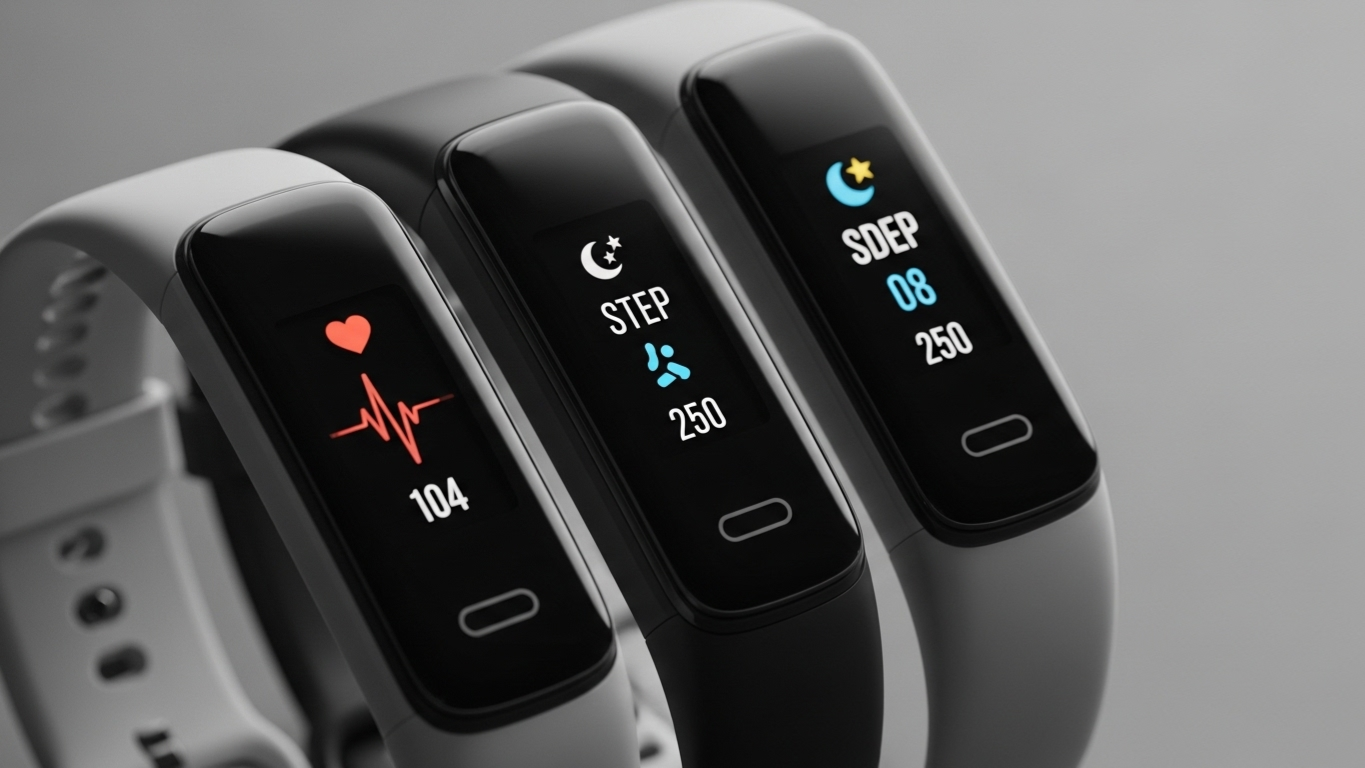
Fitness trackers, also called smart fitness trackers, remain one of the most accessible and focused categories in wearable technology. While smartwatches have expanded into multifunctional devices with app ecosystems and communication features, fitness trackers continue to prioritize what they were originally designed to do: monitor physical activity, health metrics, and recovery with efficiency, simplicity, and extended battery life.
Definition: Fitness Tracker
A fitness tracker is a purpose-built wearable device designed to measure and analyze physical activity and health metrics throughout the day. It continuously monitors data such as step count, heart rate, sleep stages, calorie expenditure, and recovery trends using motion sensors and optical heart rate technology. Unlike multifunction smartwatches, fitness trackers prioritize battery efficiency, lightweight form, and focused wellness insights over app ecosystems and communication features.
In 2026, the distinction between fitness trackers vs smartwatches is more nuanced than ever. Yet the category is far from obsolete. In fact, for many users, a dedicated fitness tracker is still the more practical and strategically aligned choice.
This comprehensive guide explains:
- What a fitness tracker is
- How fitness trackers differ from smartwatches
- The core features of modern smart fitness trackers
- Accuracy considerations and limitations
- Who should choose a fitness tracker
- Whether fitness trackers remain relevant today
This page serves as an educational reference designed to clarify the category and support informed decision-making.
What Is a Fitness Tracker?
A fitness tracker is a wearable device designed primarily to monitor physical activity, health metrics, and recovery indicators. Unlike a smartwatch, its core objective is health and performance tracking rather than communication or app interaction.
Most smart fitness trackers are worn on the wrist in a slim band-style form factor. They prioritize:
- Continuous activity tracking
- Heart rate monitoring
- Sleep analysis
- Long battery life
- Lightweight design
Companies such as Fitbit, Garmin, and Xiaomi have historically led the fitness tracker category, focusing on data-driven wellness insights rather than full-scale app ecosystems.
Core Philosophy of Fitness Trackers
Fitness trackers emphasize:
- Health-first functionality
- Minimal distraction
- Battery efficiency
- Data accessibility via companion apps
Where smartwatches attempt to replicate aspects of smartphone functionality, fitness trackers are optimized for structured health monitoring.
The Core Capabilities of Fitness Trackers
Today’s fitness trackers are significantly more advanced than early pedometer-based devices. Below are the primary capabilities that define the category.
1. Activity Tracking
Activity tracking remains the foundational feature of any fitness tracker.
Common metrics include:
- Step count
- Distance estimation
- Active minutes
- Calorie expenditure (estimated)
- Floors climbed
- Sedentary reminders
Many devices now include automatic workout detection for walking, running, cycling, and gym-based activities.
From an algorithmic standpoint, step tracking relies on accelerometers and motion sensors. While generally reliable, slight variations occur depending on wrist dominance and gait pattern.
2. Heart Rate & Cardiovascular Monitoring
Most fitness trackers use optical heart rate sensors (photoplethysmography or PPG) to measure pulse via light-based detection.
Capabilities often include:
- Continuous heart rate monitoring
- Resting heart rate trends
- Heart rate zones during workouts
- VO₂ max estimation (select models)
- Heart rate variability (HRV) insights
HRV-based analytics are increasingly used to estimate recovery and stress levels. However, these values are proxies derived from algorithms rather than clinical diagnostics.
3. Sleep Tracking
Sleep tracking has become one of the strongest differentiators for dedicated fitness trackers.
Common sleep features include:
- Total sleep duration
- Sleep stages (light, deep, REM)
- Sleep score systems
- Sleep consistency tracking
- Restlessness detection
Sleep staging is algorithm-based and inferred from movement and heart rate patterns. It provides directional insights rather than laboratory-grade precision.
4. Recovery and Stress Monitoring
Modern fitness trackers often incorporate recovery metrics derived from HRV and resting heart rate patterns.
Examples include:
- Daily readiness scores
- Stress level estimations
- Guided breathing sessions
- Mindfulness reminders
These features appeal to users focused on holistic wellness rather than pure athletic performance.
5. GPS Capabilities in Fitness Trackers
Fitness trackers may offer:
- Connected GPS (uses smartphone GPS)
- Built-in GPS (independent satellite tracking)
Built-in GPS allows independent outdoor tracking but increases battery consumption and device cost. Connected GPS preserves battery life but requires a smartphone nearby.
Battery trade-offs are central to understanding this design choice.
Fitness Trackers vs Smartwatches: A Technical Comparison
The most common question is whether a fitness tracker is better than a smartwatch. The answer depends entirely on user intent.
For comparison, consider multifunctional smartwatches such as the Apple Watch or Samsung Galaxy Watch.
Structural Comparison
| Category | Fitness Trackers | Smartwatches |
|---|---|---|
| Primary Focus | Health & activity tracking | Communication + apps + health |
| Battery Life | 5–14+ days typical | 1–3 days typical |
| App Ecosystem | Limited | Extensive |
| Notifications | Basic | Advanced, interactive |
| Price Range | Lower to mid-tier | Mid to premium |
| Form Factor | Slim, lightweight | Larger, heavier |
| Use Case | Structured wellness | Multifunction device |
Battery Life Differences
Fitness trackers achieve longer battery life because they:
- Use smaller displays
- Limit third-party apps
- Reduce background processes
- Optimize sensor polling frequency
Smartwatches operate closer to mini smartphones, requiring greater power draw.
User Intent Differences
Fitness trackers are ideal for users who:
- Want health insights without distraction
- Prefer minimal notifications
- Value multi-day battery life
- Seek budget-friendly wearables
Smartwatches serve users who:
- Want call and text integration
- Use third-party apps
- Need navigation and voice assistants
- Prioritize connectivity
The categories overlap, but they are not identical.
Who Should Choose Fitness Trackers?
Fitness trackers are particularly well-suited for:
1. Beginners Entering Structured Fitness
Users starting a health journey benefit from simple, actionable metrics without overwhelming complexity.
2. Wellness-Focused Professionals
Individuals managing stress, sleep, and recovery often prefer distraction-free monitoring.
3. Minimalist Users
Those who want health data but not constant notifications.
4. Budget-Conscious Buyers
Fitness trackers generally offer lower entry prices compared to smartwatches.
5. Long Battery Life Seekers
Travelers and endurance users benefit from extended usage between charges.
Accuracy and Limitations of Fitness Trackers
For credibility, it is essential to address constraints.
Optical Heart Rate Accuracy
- Generally accurate during steady-state exercise
- Less precise during high-intensity interval training
- Influenced by skin tone, motion artifacts, and fit
Step Counting Variability
- Wrist movement can inflate step counts
- Pushing strollers or carrying items may reduce accuracy
Sleep Stage Estimation
- Inferred from motion and heart rate
- Not equivalent to polysomnography
GPS Limitations in Fitness Trackers
- Signal obstruction in urban or wooded environments
- Connected GPS accuracy depends on smartphone quality
Medical Disclaimer
Medical Disclaimer
Fitness trackers are consumer wearable devices designed for general wellness and activity monitoring. They are not classified as medical devices and should not be used to diagnose, treat, or replace professional clinical evaluation.
Regulatory reference: U.S. Food and Drug Administration (FDA) – Digital Health & Wearables
The Evolution of Fitness Trackers
The category has progressed significantly:
- Early pedometers tracking steps only
- First-generation wrist trackers emphasizing calorie burn
- Integration of heart rate sensors
- Expansion into sleep tracking
- Recovery analytics and subscription ecosystems
- Convergence with smartwatch features
Simultaneously, adjacent form factors such as smart rings — including devices like the Oura Ring — have expanded the broader wearable health ecosystem.
Despite convergence, fitness trackers retain distinct positioning through simplicity and battery efficiency.
Are Fitness Trackers Still Relevant in 2026?
Yes — but for specific reasons.
1. Health-First Design
Fitness trackers are optimized around activity and recovery, not communication.
2. Battery Advantage
Multi-day battery life remains a major differentiator for fitness trackers.
3. Simplicity
Fitness trackers offer simplified interfaces which generate less cognitive load compared to smartwatch ecosystems.
4. Cost Efficiency
Fitness trackers generally come at lower price tiers which make them accessible entry points.
5. Focused Data Experience
Companion apps for often deliver structured health dashboards without excessive feature bloat.
Rather than disappearing, the category has matured into a clearly defined niche within wearable technology.
How to Choose the Right Fitness Trackers
When evaluating fitness trackers, consider the following framework:
Define Your Primary Goal
- Weight loss
- Sleep improvement
- Endurance training
- Stress management
Clarity here determines feature relevance.
Evaluate Battery Expectations
- Do you want 7–14 days between charges?
- Is daily charging acceptable?
Battery life often shapes device architecture.
Consider Ecosystem Lock-In
Many brands integrate tightly with proprietary apps and subscription models. Switching ecosystems may require historical data migration.
Assess Comfort and Wearability
Since fitness trackers are designed for 24/7 wear, comfort matters more than screen size.
Understand Subscription Models
Some devices unlock advanced insights via premium subscriptions. Evaluate long-term cost.
Frequently Asked Questions About Fitness Trackers
What is a fitness tracker?
A fitness tracker is a wearable device designed primarily to monitor physical activity, heart rate, sleep, and recovery metrics. It prioritizes health tracking over communication features.
Is a fitness tracker different from a smartwatch?
Yes. A fitness tracker focuses on activity and health metrics, while a smartwatch offers broader functionality such as apps, messaging, and calling features.
Are fitness trackers accurate?
Fitness trackers provide generally reliable estimates for steps and resting heart rate. However, they are not medical-grade devices and may show variability during high-intensity exercise or complex sleep staging.
Do fitness trackers require a subscription?
Not always. Basic features are typically included. Some brands offer optional premium subscriptions for advanced analytics and deeper insights.
Can a fitness tracker replace a smartwatch?
For users primarily focused on health and fitness, yes. For users needing communication and app functionality, a smartwatch may be more appropriate.
How long does the battery last in fitness trackers?
Battery life in smart fitness trackers commonly ranges from 5 to 14 days depending on GPS usage, display type, and sensor frequency.
Final Perspective on Fitness Trackers
Fitness trackers occupy a clearly defined space within wearable technology. They are not simplified smartwatches; they are purpose-built health monitoring devices.
In 2026, the decision between a smart fitness tracker and a smartwatch is less about technological superiority and more about user intent. For individuals prioritizing:
- Activity tracking
- Sleep analysis
- Recovery monitoring
- Long battery life
- Minimal distraction
A dedicated fitness tracker remains a highly rational and efficient choice.
As wearable technology continues evolving, clarity of purpose becomes increasingly valuable. Smart Fitness trackers deliver precisely that.