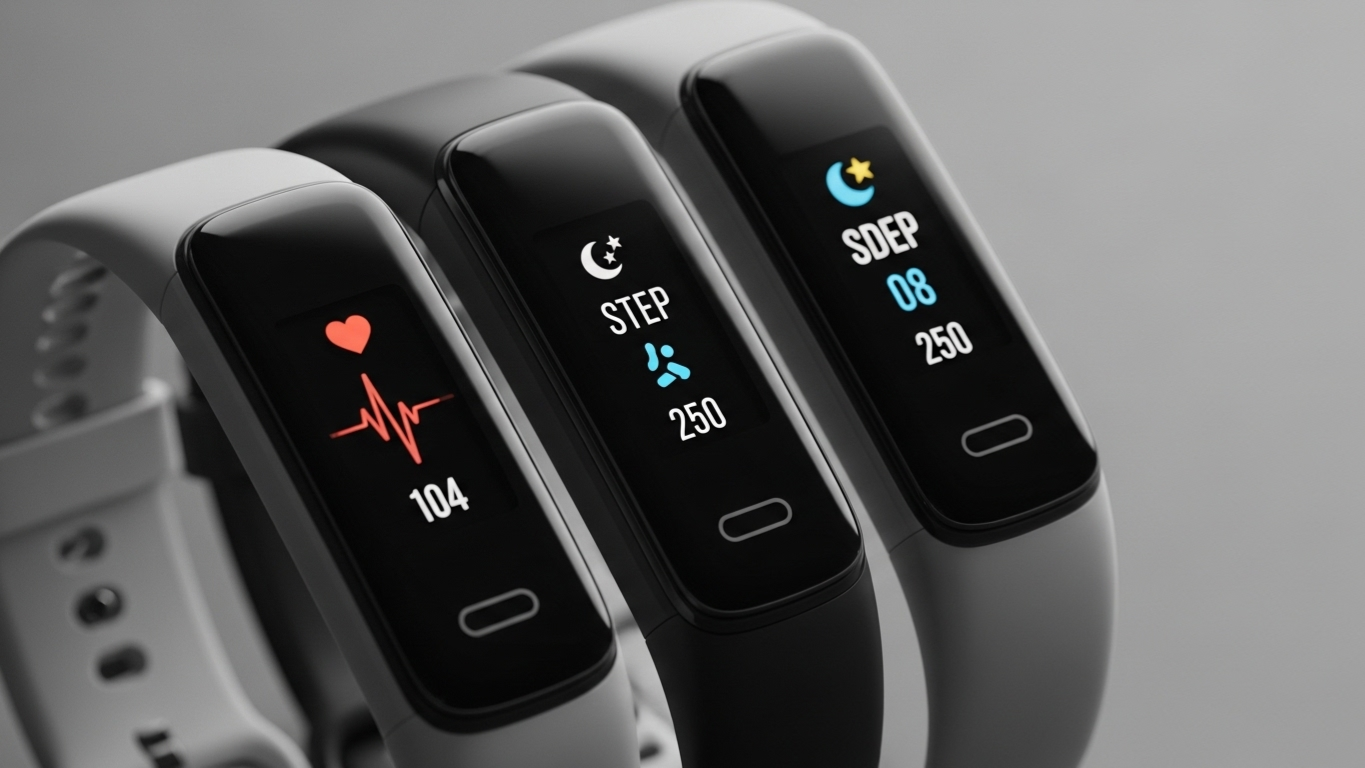
Fitness trackers, also called smart fitness trackers, remain one of the most accessible and focused categories in wearable technology. While smartwatches have expanded into multifunctional devices with app ecosystems and communication features, fitness trackers continue to prioritize what they were originally designed to do: monitor physical activity, health metrics, and recovery with efficiency, simplicity, and extended battery life.
WFT Definition: Fitness Tracker
A fitness tracker is a purpose-built wearable device designed to measure and analyze physical activity and health metrics throughout the day. It continuously monitors data such as step count, heart rate, sleep stages, calorie expenditure, and recovery trends using motion sensors and optical heart rate technology. Unlike multifunction smartwatches, fitness trackers prioritize battery efficiency, lightweight form, and focused wellness insights over app ecosystems and communication features.
In 2026, the distinction between a fitness tracker and a smartwatch is more nuanced than ever. Yet the category is far from obsolete. In fact, for many users, a dedicated fitness tracker is still the more practical and strategically aligned choice.
This comprehensive guide explains:
- What a fitness tracker is
- How fitness trackers differ from smartwatches
- The core features of modern smart fitness trackers
- Accuracy considerations and limitations
- Who should choose a fitness tracker
- Whether fitness trackers remain relevant today
This page serves as an educational reference designed to clarify the category and support informed decision-making.
Find the Right Fitness Tracker for Your Goal
The best fitness tracker is not necessarily the device with the most features. It is the one whose measurements, wearability and software experience match what you want to improve.
What Is a Fitness Tracker?
A fitness tracker is a wearable device designed primarily to monitor physical activity, health metrics, and recovery indicators. Unlike a smartwatch, its core objective is health and performance tracking rather than communication or app interaction.
Most smart fitness trackers are worn on the wrist in a slim band-style form factor. They prioritize:
- Continuous activity tracking
- Heart rate monitoring
- Sleep analysis
- Long battery life
- Lightweight design
Companies such as Fitbit, Garmin, and Xiaomi have historically led the fitness tracker category, focusing on data-driven wellness insights rather than full-scale app ecosystems.
Primary Philosophy of Fitness Trackers
Fitness trackers are designed around focused, continuous health monitoring rather than broad smartwatch functionality. Their value comes from collecting useful data with minimal effort or interruption.
This design philosophy rests on four principles:
- Health-first functionality: Activity, heart rate, sleep, stress and recovery metrics remain central to the experience.
- Minimal distraction: Notifications and interactive features are limited, allowing users to monitor their health without bringing the full smartphone experience to their wrist.
- Battery efficiency: Simplified displays and fewer background processes help many fitness trackers operate for several days between charges.
- App-based intelligence: The tracker collects data continuously, while the companion app organizes it into trends, scores and longer-term insights.
In practical terms, fitness trackers prioritize consistent monitoring over constant interaction. This makes them particularly useful for people who want structured health information, longer battery life and a lightweight wearable without the complexity of a full smartwatch.
This focused design philosophy also helps explain the growing interest in screenless fitness trackers, which take minimal-distraction tracking a step further.
The Rise of Screenless Fitness Trackers
One of the most important developments in fitness tracking in 2026 is the emergence of screenless wearables. Devices such as Fitbit Air and Garmin CIRQA move detailed health information away from the wrist display and into the companion app.
Instead of encouraging frequent checking, these devices concentrate on continuous sensing, comfortable long-term wear and insights delivered when the user chooses to review them.
from display-first tracking toward passive health monitoring and ambient wellness intelligence.
Why Screenless Tracking Appeals
- Fewer notifications and digital distractions
- Lightweight designs suited to continuous wear
- Greater emphasis on sleep and recovery tracking
- Potential for longer battery life
- Health insights interpreted through a companion app
The Screenless Trade-Off
- Limited immediate workout feedback
- No detailed metrics displayed on the wrist
- Greater dependence on the mobile app
- Fewer on-device controls during exercise
- Less suitable for display-dependent athletes
This movement reflects a broader trend WFT first identified in our analysis of CES 2026 wearable innovations : wearable technology is becoming less demanding of attention while working more continuously in the background.
Explore the New Generation of Screenless Trackers
Examine each tracker separately or compare their approaches to passive health monitoring, fitness tracking and digital distraction.
Core Capabilities of Fitness Trackers
Modern fitness trackers have evolved far beyond basic step counters. They combine motion sensors, optical heart-rate monitoring and software algorithms to identify patterns in activity, sleep, exercise and recovery.
The usefulness of these capabilities depends on two factors: how reliably the device collects data and how clearly its companion app turns that data into actionable insights.
1. Activity Tracking
Activity tracking remains the foundation of almost every fitness tracker. Accelerometers and other motion sensors detect movement throughout the day and translate it into estimates of physical activity.
Common activity metrics include:
- Step count
- Distance travelled
- Active minutes
- Estimated calorie expenditure
- Floors climbed on supported devices
- Sedentary or movement reminders
- Automatically detected workouts
Many trackers can recognize activities such as walking, running and cycling without requiring the user to start a workout manually.
Why it matters: Activity tracking helps users understand daily movement patterns, recognize periods of inactivity and monitor consistency over time. It is particularly useful for beginners and anyone building more regular movement into their routine.
Practical limitation: Step counts and calorie estimates are not exact measurements. Results can be affected by wrist movement, gait, device position and whether the tracker is worn on the dominant hand. These metrics are generally more useful for identifying trends than evaluating a single day in isolation.
2. Heart Rate and Cardiovascular Monitoring
Most modern fitness trackers use photoplethysmography, commonly called PPG, to estimate heart rate. Green LED lights illuminate the skin while optical sensors detect changes in blood volume with each heartbeat.
Depending on the device, heart-related capabilities may include:
- Continuous heart-rate monitoring
- Resting heart-rate trends
- Heart-rate zones during exercise
- High or low heart-rate notifications
- Heart-rate recovery
- VO₂ max or cardiovascular fitness estimates
- Heart-rate variability insights
Why it matters: Heart-rate data helps users understand workout intensity, observe changes in cardiovascular fitness and identify how the body responds to exercise, sleep and daily stress.
Practical limitation: Wrist-based heart-rate tracking is typically more dependable during rest and steady movement than during rapid, high-intensity or irregular exercise. Device fit, motion, skin contact and sensor placement can all affect readings.
Heart-rate variability should also be interpreted against an individual’s normal baseline. HRV values and recovery calculations may not be directly comparable across brands because manufacturers use different sensors, algorithms and measurement periods.
3. Sleep Tracking
Sleep tracking has become one of the strongest use cases for lightweight fitness trackers. Their compact design and multi-day battery life can make them easier to wear overnight than larger smartwatches.
Common sleep features include:
- Total sleep duration
- Bedtime and wake-up time
- Sleep stages such as light, deep and REM
- Sleep scores
- Sleep consistency
- Night-time restlessness
- Overnight heart-rate and HRV trends
Fitness trackers infer sleep from a combination of movement, heart rate and other physiological signals. The companion app then organizes these measurements into sleep stages, trends or simplified scores.
Why it matters: Sleep tracking can help users identify inconsistent schedules, insufficient sleep duration and changes associated with exercise, stress, travel or lifestyle habits.
Practical limitation: Consumer wearables do not directly measure sleep in the same way as a clinical sleep study. Sleep stages and scores are algorithmic estimates and should be treated as directional insights rather than laboratory-grade findings.
For practical use, long-term sleep duration and consistency may be more informative than focusing too heavily on a single sleep-stage result.
4. Recovery and Stress Monitoring
Recovery and stress features combine several signals to estimate how prepared the body may be for activity or how it is responding to physical and psychological demands.
Inputs may include:
- Resting heart rate
- Heart-rate variability
- Recent activity or training load
- Sleep duration and quality
- Breathing rate
- Skin temperature on supported devices
- Long-term personal baselines
These inputs may be presented as:
- Daily readiness or recovery scores
- Stress-level estimates
- Body-energy indicators
- Training recommendations
- Guided breathing exercises
- Mindfulness reminders
Why it matters: Recovery insights can help users decide whether to train normally, reduce intensity or prioritize rest. Stress trends may also encourage greater awareness of how sleep, workload and daily habits affect wellbeing.
Practical limitation: Readiness and stress scores are proprietary interpretations rather than standardized medical measurements. Two brands can evaluate similar physiological data and produce different scores or recommendations.
These features are most useful when viewed alongside how the user actually feels, rather than being treated as instructions that must always be followed.
5. GPS and Location Tracking
GPS allows a fitness tracker to estimate outdoor distance, pace, speed and route. However, not every tracker contains its own satellite receiver.
There are two main approaches:
- Connected GPS: The tracker uses the paired smartphone’s GPS. This helps preserve battery life and reduce device cost, but the phone must be carried during the activity.
- Built-in GPS: The tracker connects to satellites independently. This allows phone-free route, distance and pace tracking but generally uses more battery power.
Why it matters: GPS is particularly valuable for runners, cyclists, hikers and open-water swimmers who need more accurate distance, pace and route information.
Practical limitation: GPS performance can vary in cities, wooded areas, valleys and other environments where buildings or terrain obstruct satellite signals. Continuous GPS use can also reduce battery life substantially compared with everyday tracking.
Before choosing a device, consider whether you genuinely need phone-free GPS or whether connected GPS would satisfy your normal activities.
Practical Takeaway
A fitness tracker does not need every available capability to be useful. Its core features should support the user’s primary goals while remaining comfortable enough for consistent wear.
For everyday wellness, activity, heart-rate and sleep trends may be sufficient. Athletes may need built-in GPS, training metrics and deeper recovery insights. Users focused on sleep or minimal distraction may benefit more from comfort, battery life and clear app-based interpretation than from a large display or extensive on-device controls.
Fitness Trackers vs Smartwatches: A Technical Comparison
Fitness trackers and smartwatches increasingly share features such as heart rate monitoring, sleep tracking, GPS, and workout modes. However, their underlying design priorities remain different.
Fitness trackers generally emphasize continuous health and activity monitoring, lightweight wearability, simplicity, and longer battery life. Smartwatches combine health tracking with apps, communication, navigation, and broader smartphone integration.
Neither category is universally better. The right choice depends on whether you value focused wellness tracking or multifunctional on-wrist computing. For a deeper evaluation of features, cost, battery life, accuracy, and ideal users, read our complete fitness trackers versus smartwatches comparison.
The structural comparison table below summarizes the principal differences.
Structural Comparison
| Category | Fitness Trackers | Smartwatches |
|---|---|---|
| Primary Focus | Health and activity tracking | Communication, apps and health |
| Battery Life | Typically 5–14+ days | Typically 1–3 days |
| App Ecosystem | Limited | Extensive |
| Notifications | Basic | Advanced and interactive |
| Price Range | Lower to mid-tier | Mid-tier to premium |
| Form Factor | Slim and lightweight | Larger and heavier |
| Typical Use Case | Structured wellness tracking | Multifunction wearable device |
Swipe horizontally to view the full comparison table.
Why Battery Life Differs
Fitness trackers generally last longer between charges because they are built around focused health monitoring rather than continuous interaction.
Their battery advantage commonly comes from:
- Smaller, simpler or completely screenless designs
- Fewer third-party apps and background processes
- Limited communication features
- Lower reliance on Wi-Fi, LTE and other power-intensive connections
- Sensor and software settings optimized for continuous, low-power monitoring
Smartwatches operate more like compact wrist-worn computers. Larger displays, interactive notifications, apps, voice assistants, wireless connectivity and frequent user interaction all require additional power.
Why this matters in practice: Longer battery life makes fitness trackers easier to wear continuously, particularly overnight. Smartwatch users may need to plan charging around sleep or exercise to avoid gaps in their data.
Manufacturer battery estimates should still be treated as guidelines. Always-on displays, GPS, workout frequency, notifications and sensor settings can significantly affect real-world performance.
Choose According to User Intent
The better category depends on what you want the wearable to do throughout the day.
A fitness tracker may be the better choice if you:
- Primarily want activity, heart-rate, sleep and recovery insights
- Prefer a lightweight device for continuous wear
- Want fewer notifications and digital distractions
- Value several days of battery life
- Prefer a simpler and potentially more affordable wearable
A smartwatch may be the better choice if you:
- Want to make calls, respond to messages or manage notifications
- Use third-party apps directly from your wrist
- Need navigation, music controls or voice-assistant access
- Want deeper integration with your smartphone
- Prefer an interactive display and broader everyday functionality
Who Should Choose Fitness Trackers?
Fitness trackers are best suited to people who want consistent health and activity monitoring without the cost, complexity or frequent charging associated with a full smartwatch.
They can be particularly valuable for the following users.
1. Beginners Building Healthier Habits
A fitness tracker can provide an accessible introduction to structured health monitoring. Metrics such as steps, active minutes, resting heart rate and sleep duration give beginners clear starting points without presenting too much information at once.
What to prioritize: Simple navigation, automatic activity detection, understandable progress summaries and an easy-to-use companion app.
Beginners should avoid paying extra for advanced performance metrics they are unlikely to use.
2. Wellness-Focused Professionals
Professionals balancing work, exercise, sleep and stress may benefit from a lightweight tracker that works quietly in the background.
Sleep consistency, resting heart rate, HRV trends and stress estimates can help users understand how workload, travel and daily routines may be affecting their wellbeing.
What to prioritize: Comfortable overnight wear, multi-day battery life, sleep and recovery insights, and limited notifications.
These users may find a low-distraction or screenless tracker particularly appealing.
3. Minimalist and Low-Distraction Users
Some people want access to health data without placing another interactive screen on their wrist. A traditional fitness band with restricted notifications or a completely screenless tracker can provide continuous monitoring without encouraging frequent checking.
What to prioritize: Automatic tracking, notification controls, a simple display or screenless design, and clear app-based insights.
The main trade-off is reduced access to real-time workout information and on-device controls.
4. Budget-Conscious Buyers
Fitness trackers often provide essential activity, heart-rate and sleep monitoring at a lower entry price than feature-rich smartwatches.
However, the lowest purchase price does not always produce the best long-term value. Some affordable devices restrict advanced insights behind a subscription or offer limited software support.
What to prioritize: Reliable core tracking, a good companion app, included features, warranty coverage and the total cost of any subscription.
A well-supported entry-level tracker may offer better value than a cheaper device with weak software or inconsistent data.
5. Users Who Prioritize Continuous Wear
Travelers, shift workers and sleep-focused users may benefit from a device that can operate for several days between charges. Longer battery life reduces gaps in activity, sleep and recovery data.
What to prioritize: Real-world battery life, overnight comfort, charging speed and the effect of GPS or continuous workout tracking on battery performance.
Endurance athletes should also examine GPS-mode battery life separately. A tracker may last many days during ordinary use but considerably less during continuous satellite tracking.
6. People Focused on Long-Term Patterns Rather Than Smart Features
Fitness trackers are particularly useful for people who care more about long-term patterns than calls, apps or wrist-based communication.
They can help users monitor questions such as:
- Am I becoming more active?
- Is my resting heart rate changing?
- Am I sleeping consistently?
- How does my body respond to changes in training or routine?
- Am I maintaining healthy habits over time?
What to prioritize: Clear trend reporting, reliable data synchronization and the ability to review historical information.
When a Fitness Tracker May Not Be the Best Choice
A smartwatch or dedicated sports watch may be more appropriate if you need:
- Calls, messaging and interactive notifications
- Third-party apps on your wrist
- Detailed maps and navigation
- Advanced live training metrics
- Extensive music controls or contactless features
- A large interactive display
Accuracy and Limitations of Fitness Trackers
Fitness trackers can provide valuable insight into activity, heart rate, sleep and outdoor exercise, but their measurements are estimates rather than perfect representations of the body.
Accuracy varies according to the device, sensor technology, activity, environment and how the tracker is worn. In most cases, wearable data is more useful for identifying personal trends over time than judging a single reading in isolation.
Optical Heart Rate Accuracy
Fitness trackers generally estimate heart rate using photoplethysmography, or PPG. LEDs illuminate the skin while optical sensors detect changes in blood volume associated with each heartbeat.
Wrist-based heart-rate monitoring is often most dependable at rest and during steady, rhythmic exercise. Accuracy may decrease during high-intensity intervals, strength training and activities involving rapid or irregular wrist movement.
Readings can be affected by:
- Motion and vibration
- Loose or inconsistent device fit
- Sensor placement
- Cold skin or reduced blood flow
- Sweat, dirt or material between the sensor and skin
- Individual differences in optical signal quality
Research identifies motion artifacts and optical-signal quality as important sources of PPG error. Evidence about the effect of skin tone remains mixed and may vary between devices and sensor designs. (Bent et al., 2020; Hung et al., 2025)
How to improve the reading: Wear the tracker securely above the wrist bone, keep the sensor clean and allow the device time to establish a stable reading before beginning exercise. Athletes requiring more responsive heart-rate data during intense training may benefit from a compatible chest strap.
Step Counting Variability
Step counting relies on accelerometers and algorithms that interpret repeated movement as walking or running.
Accuracy can vary when:
- Wrist movement resembles walking despite the user being stationary
- The wearer walks slowly or with an irregular gait
- The arm remains relatively still while pushing a stroller
- The user carries shopping bags or holds exercise equipment
- The tracker is worn in an unexpected position
- Different devices apply different step-detection thresholds
Research comparing wrist-worn and hip-worn devices has found that placement can affect step-count results in real-world conditions. (Nelson et al., 2022)
How to use the data: Focus on consistent daily and weekly patterns rather than small differences between devices. Wear the tracker in the same position and ensure the companion app has the correct wrist and dominant-hand settings.
Sleep Duration and Sleep-Stage Estimation
Fitness trackers estimate sleep by combining movement, heart rate and other available physiological signals. They do not directly measure the brain activity, eye movement, breathing and muscle activity recorded during clinical polysomnography.
Wearables may provide useful estimates of:
- Bedtime and wake-up time
- Total sleep duration
- Sleep consistency
- Night-time interruptions
- Longer-term sleeping patterns
Sleep-stage classifications such as light, deep and REM are more difficult to estimate accurately. Validation studies show that performance varies between devices and between individual sleep measurements. (Lee et al., 2023)
How to use the data: Prioritize longer-term patterns in sleep duration and consistency. Avoid making major decisions based on one unusual sleep score or a single night’s stage distribution.
Persistent sleep concerns should be discussed with a qualified healthcare professional rather than assessed solely through a consumer wearable.
GPS and Distance Limitations
Fitness trackers with built-in or connected GPS estimate route, distance, pace and speed using satellite positioning.
GPS accuracy can be affected by:
- Tall buildings and urban environments
- Dense trees and heavy foliage
- Valleys, mountains and other terrain
- Indoor or underground activity
- Reflected satellite signals
- Beginning an activity before a reliable GPS connection is established
The official GPS information service identifies signal blockage from buildings, bridges and trees—as well as signals reflected from surrounding structures—as common causes of positioning errors. (GPS.gov)
Connected GPS introduces another dependency because the tracker relies on the paired smartphone. Phone placement, location permissions, power-saving settings and GPS performance can therefore affect the recorded route.
How to improve the reading: Begin activities in an open area, allow the device to establish a GPS connection before moving and keep its software current. For connected GPS, confirm that the companion app has the required location permissions.
How to Interpret Fitness Tracker Data Responsibly
Fitness trackers are most useful when they help users identify changes and patterns.
For more reliable interpretation:
- Compare results from the same device rather than different brands
- Wear the tracker consistently and in the recommended position
- Focus on weekly and monthly trends
- Consider how sleep, illness, travel and device fit may affect the data
- Treat unusual readings as signals to investigate—not automatic conclusions
- Do not use consumer wearable data as a substitute for clinical diagnosis
The objective is not to expect perfect measurement from every sensor. It is to understand where the data is reasonably useful, where uncertainty exists and how that information can support better-informed health and fitness decisions.
Medical Disclaimer
Fitness trackers are consumer wearable devices designed for general wellness and activity monitoring. They are not classified as medical devices and should not be used to diagnose, treat, or replace professional clinical evaluation.
Regulatory reference: U.S. Food and Drug Administration (FDA) – Digital Health & Wearables
The Evolution of Fitness Trackers: From Step Counters to Wearable Intelligence
Fitness trackers have not simply gained more sensors. Their purpose has gradually shifted from recording movement to interpreting patterns across activity, sleep, recovery and everyday health.
The category has progressed through several important stages:
1. Basic Movement Tracking
Early pedometers focused almost entirely on counting steps. Their main purpose was to make daily movement visible and encourage users to become more active.
2. Connected Wrist-Based Tracking
Fitness tracking moved from simple clip-on devices to connected wristbands. Companion apps allowed users to review activity history, set goals and monitor progress over time.
This transformed step counting from a daily number into an ongoing habit-building system.
3. Continuous Heart-Rate Monitoring
The addition of optical heart-rate sensors expanded fitness trackers beyond movement. Devices could now estimate resting heart rate, exercise intensity, heart-rate zones and cardiovascular fitness trends.
This marked an important transition from activity tracking toward physiological monitoring.
4. Sleep, Stress and Recovery Insights
As trackers became comfortable enough for continuous wear, their role expanded into overnight and all-day monitoring.
Sleep duration, HRV trends, stress estimates and readiness scores allowed devices to provide a broader picture of how activity, rest and daily demands interact.
5. App Ecosystems and Subscription-Based Intelligence
The companion app became just as important as the wearable itself. Manufacturers began using proprietary algorithms to transform sensor data into scores, recommendations and personalized guidance.
Some brands also introduced subscriptions for advanced sleep analysis, coaching, recovery insights and AI-powered interpretation. This created a new buying consideration: the long-term value and cost of the software ecosystem.
6. Convergence and New Form Factors
Fitness trackers increasingly adopted features associated with smartwatches, while smartwatches expanded their health and fitness capabilities. At the same time, smart rings, screenless bands and recovery-focused wearables introduced alternatives to the traditional display-based wrist tracker.
The result is a more diverse wearable ecosystem in which users can choose between interactive smartwatches, lightweight fitness bands, discreet smart rings and screenless devices designed for passive monitoring.
7. The Shift Toward Wearable Intelligence
The next stage of fitness tracking is less about collecting additional data and more about interpreting existing data effectively.
AI-supported coaching, contextual recommendations and screenless designs point toward wearables that operate quietly in the background and surface guidance when it becomes useful.
The tracker is therefore evolving from a device that asks, “What did you do?” into a system that helps explain, “What does your data mean, and what should you consider doing next?”
What This Evolution Means for Buyers
For today’s buyer, basic tracking capabilities are no longer the only meaningful differentiators. It is also important to evaluate:
- How clearly the device interprets its data
- Whether the form factor supports consistent wear
- How well the companion app fits your needs
- Whether important insights require a subscription
- How easily data can be exported or shared
- Whether the tracker emphasizes wellness, athletic performance or recovery
- Whether added features justify their effect on price and battery life
Despite their increasing overlap with smartwatches and other wearable categories, fitness trackers retain a distinct role through simplicity, lightweight wearability, focused health monitoring and multi-day battery life.
Are Fitness Trackers Still Relevant in 2026?
Yes. Fitness trackers remain relevant in 2026 because they solve a different problem from smartwatches. Their strength is not the number of apps or interactive features they provide, but their ability to monitor activity, sleep and recovery continuously with less distraction, lighter hardware and longer battery life.
Several factors continue to give the category a distinct role.
1. Purpose-Built Health Monitoring
Fitness trackers are designed primarily around activity, heart rate, sleep and recovery rather than communication and wrist-based applications.
This focused approach can make the experience easier to understand for users who want health insights without navigating an extensive smartwatch ecosystem.
2. Continuous Wear and Battery Life
Multi-day battery life remains one of the category’s strongest advantages. Less frequent charging reduces gaps in activity, sleep and recovery data.
Lightweight designs can also make fitness trackers more comfortable for overnight wear, travel and continuous monitoring.
3. Simplicity and Reduced Digital Distraction
Not every user wants calls, messages and app notifications appearing on their wrist. Fitness trackers generally offer a quieter experience, with information reviewed intentionally through the device or companion app.
The emergence of screenless trackers strengthens this positioning by separating continuous health monitoring from constant screen interaction.
4. More Accessible Entry Prices
Fitness trackers commonly provide core activity, heart-rate and sleep features at lower entry prices than premium smartwatches.
This makes the category accessible to beginners, budget-conscious buyers and users who do not need advanced communication or app functionality.
Purchase price should still be considered alongside subscription costs, software support and the features included without a premium plan.
5. A Focused Data Experience
Modern companion apps can organize wearable data into trends, scores and practical summaries without requiring users to interpret every individual measurement.
The best fitness-tracker experiences focus on questions such as:
- Am I moving consistently?
- Am I getting enough sleep?
- How is my resting heart rate changing?
- Am I recovering from exercise?
- How are my habits changing over time?
This focused experience can be more useful than having a larger volume of features that the wearer rarely uses.
6. Continued Innovation in Form Factor and Intelligence
Fitness trackers are no longer limited to traditional bands with small displays. Screenless devices, recovery-focused wearables and app-based AI guidance demonstrate that the category is still evolving.
Innovation is increasingly focused on comfortable continuous wear, passive data collection and better interpretation—not simply adding more functions to the wrist.
When a Fitness Tracker Is Less Suitable
A smartwatch may remain the better choice for users who need:
- Calls and message responses
- Third-party wrist-based apps
- Detailed maps and navigation
- Extensive music controls
- A large interactive display
- Deeper smartphone integration
How to Choose the Right Fitness Tracker
Choosing the right fitness tracker is not about finding the device with the longest feature list. It is about selecting one that measures what matters to you, fits comfortably into your routine, and presents information you can understand and use.
To make the decision more systematic, WFT evaluates wearables using the WFT Wearable Evaluation Framework. It assesses devices across five weighted pillars: Health Intelligence, Performance Analytics, Recovery and Readiness, Hardware and Wearability, and Ecosystem and Software.
Use the following steps to narrow your options.
Step 1: Define Your Primary Goal
Begin with the main outcome you want the tracker to support. This prevents you from paying for advanced features that may add little practical value.
| Your Primary Goal | Features to Prioritize |
|---|---|
| Everyday Activity | Steps, active minutes, heart-rate trends and a simple companion app |
| Sleep and Recovery | Comfortable overnight wear, sleep trends, HRV insights and multi-day battery life |
| Running and Endurance | Built-in GPS, heart-rate zones, pace, VO₂ max estimates and training-load insights |
| Stress and General Wellness | Stress trends, guided breathing, sleep insights and long-term health patterns |
| Swimming | Appropriate water-resistance rating, swim modes, lap detection and stroke metrics |
| Minimal Distraction | Screenless or low-distraction design, automatic tracking and clear app-based insights |
Swipe horizontally to view the full table.
Try to identify one primary goal and no more than two secondary goals.
Step 2: Separate Essential Features from Nice-to-Have Features
Create a short list before comparing devices:
- Three features you definitely need
- Two features that would be useful
- Features you are unlikely to use
For example, a recreational walker may need reliable step tracking, heart-rate trends and sleep monitoring, but may not benefit from advanced running dynamics or multisport navigation.
This makes comparisons easier and reduces the risk of choosing a device based primarily on marketing claims.
Step 3: Consider Wearability and Battery Life
A fitness tracker produces its most useful trends when it is worn consistently. Comfort and charging requirements should therefore be treated as core features rather than minor design details.
Ask yourself:
- Is it comfortable enough to wear overnight?
- Will its size interfere with sleep, work or exercise?
- How often am I willing to charge it?
- Can it record sleep without needing to be charged overnight?
- Is its water-resistance rating suitable for my activities?
- Do I want a screen, a small display or a completely screenless design?
A feature-rich tracker offers limited value if it is uncomfortable or frequently left on the charger.
Step 4: Check Smartphone and Ecosystem Compatibility
The companion app determines how easily you can interpret the data collected by the device.
Before buying, confirm:
- Compatibility with your iPhone or Android phone
- Integration with services such as Apple Health, Health Connect or Strava
- Whether historical data can be exported
- Whether important insights are easy to understand
- Whether switching brands could make previous data difficult to retain
If you already use a particular health or training platform, choosing a compatible tracker can reduce friction.
Step 5: Understand the Full Cost
Consider the cost of ownership rather than the purchase price alone.
Check whether the device requires:
- A monthly or annual subscription
- A premium plan for sleep, readiness or AI-generated insights
- Replacement bands or proprietary accessories
- Paid coaching or training features
Identify which features are included with the device and which remain behind a subscription. A cheaper tracker can become more expensive over time if its most useful insights require an ongoing payment.
Step 6: Understand Accuracy and Limitations
Consumer fitness trackers are most useful for identifying patterns and changes over time. Individual measurements can vary with movement, device fit, skin contact, exercise intensity and the algorithms used by each manufacturer.
Consider whether the device is sufficiently reliable for your intended activity rather than assuming every metric offers medical or laboratory-grade precision.
For more context, read WFT’s guide to wearable-device accuracy and limitations.
Final Checklist Before You Buy
Before making your decision, confirm that:
- The tracker supports your primary goal
- Your essential features are included
- It works with your smartphone
- It is comfortable enough for regular or overnight wear
- Its battery life matches your routine
- Its water resistance matches your activities
- You understand any subscription costs
- Its companion app presents information you can use
- The manufacturer provides an acceptable warranty and return policy
When two devices meet your technical requirements, the better choice is usually the one you are more likely to wear consistently and whose insights you find easier to understand.
Frequently Asked Questions About Fitness Trackers
What is a fitness tracker?
A fitness tracker is a wearable device designed primarily to monitor physical activity, heart rate, sleep, and recovery metrics. It prioritizes health tracking over communication features.
Is a fitness tracker different from a smartwatch?
Yes. A fitness tracker focuses on activity and health metrics, while a smartwatch offers broader functionality such as apps, messaging, and calling features.
Are fitness trackers accurate?
Fitness trackers provide generally reliable estimates for steps and resting heart rate. However, they are not medical-grade devices and may show variability during high-intensity exercise or complex sleep staging.
Do fitness trackers require a subscription?
Not always. Basic features are typically included. Some brands offer optional premium subscriptions for advanced analytics and deeper insights.
Can a fitness tracker replace a smartwatch?
For users primarily focused on health and fitness, yes. For users needing communication and app functionality, a smartwatch may be more appropriate.
How long does the battery last in fitness trackers?
Battery life in smart fitness trackers commonly ranges from 5 to 14 days depending on GPS usage, display type, and sensor frequency.
Final Perspective on Fitness Trackers
Fitness trackers remain valuable because they provide focused health information without requiring the complexity, interaction or charging frequency associated with many smartwatches.
Their practical advantages—lightweight wearability, multi-day battery life, minimal distraction and continuous activity, sleep and recovery monitoring—can make them particularly effective for long-term use.
Ultimately, the choice is not about which wearable category is technologically superior. It is about the fit between the user’s goals, the device’s capabilities and the quality of the insights it provides.
The best fitness tracker is not necessarily the one that collects the most metrics. It is the one that captures relevant data consistently, presents it clearly and helps the wearer make better-informed decisions.
If you are ready to compare your options, use our step-by-step fitness tracker selection guide and apply the WFT Wearable Evaluation Framework to assess each device systematically.