Introduction
Choosing the right wearable fitness tracker has become increasingly complex.
From smartwatches and fitness bands to smart rings and recovery-focused devices, the market is now filled with options that promise better health insights, improved performance, and smarter training decisions.
But here’s the reality:
Not all wearables are built the same—and choosing the wrong one can lead to misleading data, poor insights, and wasted investment.
This guide provides a structured, data-driven approach to help you choose the right device based on your goals, lifestyle, and performance needs.
By the end of this guide, you will:
- Understand the different types of wearable fitness trackers
- Know which features actually matter
- Apply a professional evaluation framework
- Confidently choose the right device for your needs
What Is a Wearable Fitness Tracker?
A wearable fitness tracker is a device designed to monitor and analyze physical activity, physiological signals, and recovery metrics.
Modern wearables go far beyond step counting. They now function as:
Personal performance intelligence systems
Types of Wearable Fitness Trackers
Understanding device categories is the first step in making the right choice.
1. Fitness Bands
- Lightweight and simple
- Focus on steps, calories, and basic heart rate
- Long battery life
👉 Best for beginners and casual users
🔗 Explore more about fitness trackers: https://wearablefitnesstech.com/fitnesstrackers/
2. Smartwatches
- All-in-one devices with apps, notifications, and advanced tracking
- Built-in GPS, workout tracking, and ecosystem integrations
👉 Best for users who want versatility
🔗 Explore more about smartwatches: https://wearablefitnesstech.com/smartwatches/
3. Smart Rings
- Compact and discreet
- Strong focus on sleep, recovery, and readiness metrics
👉 Best for recovery-focused users
🔗 Explore more about Smart Rings: https://wearablefitnesstech.com/smartrings/
4. Screenless Recovery Trackers
- Continuous monitoring with minimal interaction
- Strong emphasis on strain, recovery, and HRV
👉 Best for performance optimization
🔗 Explore more about Screenless Recovery Trackers: https://wearablefitnesstech.com/recoverytrackers/
Why Choosing the Right Tracker Matters
A wearable is only as valuable as the accuracy and relevance of its data.
Choosing the wrong device can lead to:
- Inaccurate heart rate or sleep data
- Misleading recovery insights
- Poor training decisions
🔗 Learn more about wearable device accuracy:
https://wearablefitnesstech.com/wearable-device-accuracy/
The goal is not just tracking—it’s actionable insight.
Step 1 — Define Your Fitness & Health Goals
Before looking at devices, define your primary objective.
Goal → Feature Mapping
| Goal | Key Features Required |
|---|---|
| Weight Loss | Steps, calories, activity tracking |
| Endurance Training | GPS, heart rate zones, VO2 max |
| Strength Training | Workout tracking, reps (limited accuracy) |
| Recovery & Sleep | HRV, sleep stages, readiness scores |
| General Health | Heart rate, activity trends |
Step 2 — Understand Key Tracking Capabilities
Core Metrics
- Steps
- Calories burned
- Heart rate
Advanced Metrics
- Heart Rate Variability (HRV)
- VO2 Max
- Sleep staging
- Stress tracking
Sensor Technology Behind the Data
- Optical heart rate sensors
- GPS tracking
- Accelerometers
👉 These directly impact data reliability
🔗 Related the device accuracy guide: https://wearablefitnesstech.com/wearable-device-accuracy/
Step 3 — Choose the Right Type of Wearable
Device Comparison Table
| Feature | Fitness Band | Smartwatch | Smart Ring | Recovery Tracker |
|---|---|---|---|---|
| Heart Rate | ✔️ | ✔️ | ✔️ | ✔️ |
| GPS | ❌ | ✔️ | ❌ | ❌ |
| Sleep Tracking | Basic | Advanced | Advanced | Advanced |
| Battery Life | Long | Medium | Long | Long |
| Smart Features | Minimal | Extensive | None | Minimal |
Step 4 — Apply the WFT Wearable Evaluation Framework
This is where your decision becomes data-driven.
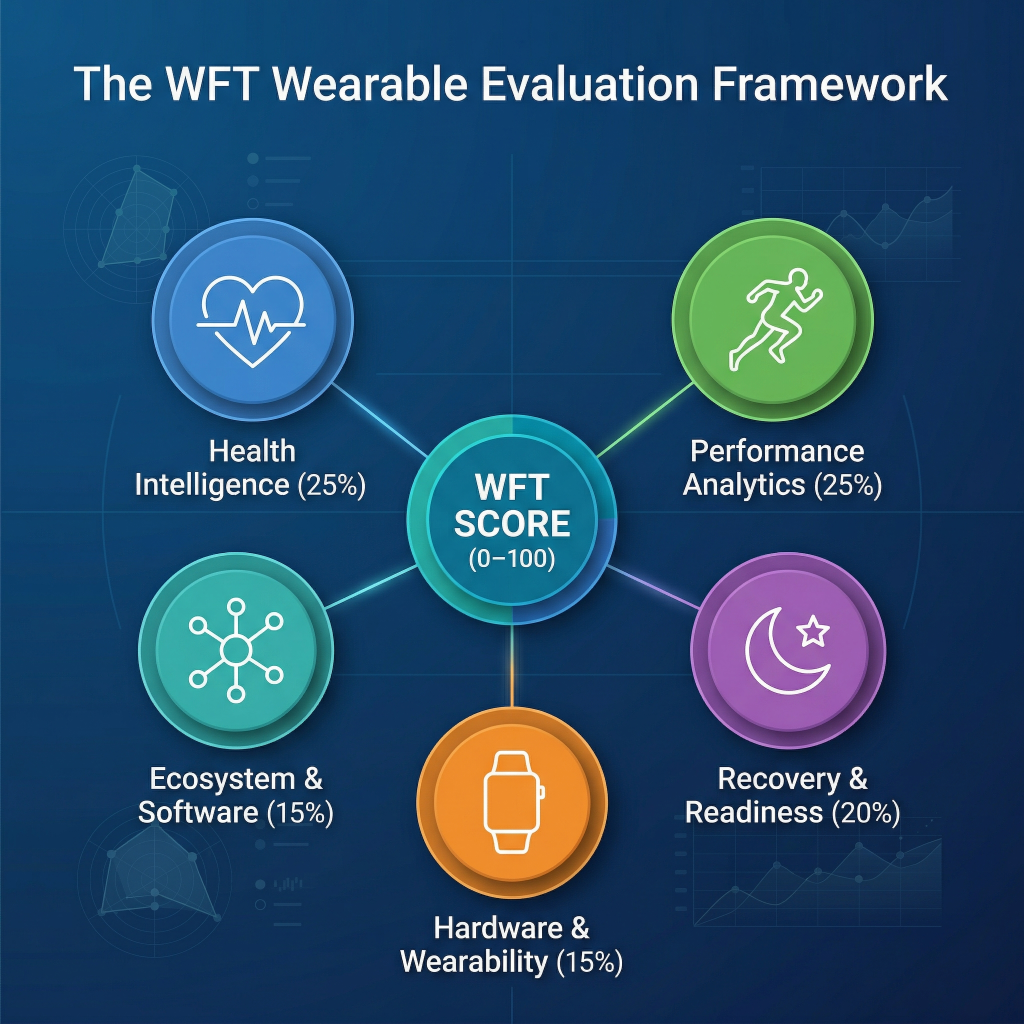
WFT Score (0–100)
A structured scoring system used to evaluate wearable devices across five key pillars.
WFT Framework Visualization
The 5 Pillars
Health Intelligence (25%)
- Accuracy of biometrics
- Depth of health insights
Performance Analytics (25%)
- Training metrics
- Workout tracking depth
Recovery & Readiness (20%)
- HRV
- Sleep analysis
- Recovery scoring
Hardware & Wearability (15%)
- Comfort
- Battery life
- Build quality
Ecosystem & Software (15%)
- App experience
- Data insights
- Integrations
🔗 Explore the full framework:
https://wearablefitnesstech.com/wft-wearable-evaluation-framework/
How to Use the Framework
Evaluate any device by asking:
- Does it provide accurate data?
- Does it generate meaningful insights?
- Does it align with my goals?
Step 5 — Match Your Profile to the Right Tracker
Beginner / Lifestyle User
👉 Fitness band or entry smartwatch
Fitness Enthusiast
👉 Advanced smartwatch
Endurance Athlete
👉 GPS smartwatch
Data-Driven / Biohacker
👉 Smart ring or recovery tracker
Quick Decision Guide
- Want simplicity → Fitness band
- Want performance insights → Recovery tracker / smart ring
- Want all-in-one → Smartwatch
Common Mistakes to Avoid
- Choosing based on brand instead of data
- Ignoring accuracy
- Overpaying for unused features
- Not considering ecosystem compatibility
Final Checklist Before You Buy
✔️ Defined your goals
✔️ Selected device category
✔️ Evaluated key features
✔️ Applied WFT framework
Frequently Asked Questions
What is the most accurate fitness tracker?
Accuracy varies by brand and sensor quality, but devices with advanced optical sensors and validated algorithms perform best.
Are fitness trackers worth it?
Yes—when used correctly, they provide actionable insights for improving health and performance.
Fitness trackers vs smartwatches—what’s better?
Fitness trackers are simpler and focused. Smartwatches offer broader functionality.
Do I need HRV tracking?
HRV is valuable for recovery and readiness insights, especially for active individuals.
Explore More Wearable Fitness Technology Guides
- https://wearablefitnesstech.com/fitness-trackers/
- https://wearablefitnesstech.com/smartwatches/
- https://wearablefitnesstech.com/wft-wearable-evaluation-framework/
- https://wearablefitnesstech.com/fitness-trackers-vs-smartwatches/
Conclusion
Choosing the right wearable fitness tracker is not about features alone.
It’s about selecting a device that delivers meaningful, accurate, and actionable performance intelligence.
When you combine:
- Clear goals
- The right device type
- A structured evaluation framework
You move from simply tracking activity to optimizing performance and health.