Introduction: AI Wearables, Health-First, and Beyond
The wearables industry reached a defining inflection point at the Consumer Electronics Show CES 2026 wearable trends showcase. What once centered on step counts, heart rate, and activity dashboards is rapidly evolving into something more ambitious: intelligent health systems that interpret, predict, and guide human performance in real time.
Across product showcases, concept demos, and emerging technologies, one theme was unmistakable—wearables are no longer about collecting data. They are about understanding it, acting on it, and integrating it seamlessly into daily life. Artificial intelligence, health-first design, and new form factors are reshaping what wearable technology means for fitness, recovery, stress management, and long-term wellbeing.
This article breaks down the wearable technology landscape unveiled at the CES 2026 event into three layers: the macro trends reshaping the industry, the specific innovations driving those shifts, and the real-world product showcases that bring them to life.
Why CES 2026 Matters for the Wearables Industry
CES has long functioned as a global preview of emerging technology. But for wearable technology, CES 2026 represented a structural inflection point—marking the industry’s shift from devices that merely track data to intelligent systems that interpret, contextualize, and act on it.
Across hundreds of product demonstrations, research showcases, and platform announcements, a clear pattern emerged. After synthesizing the wearable technology innovations unveiled at CES 2026, four distinct trends now define the future of wearables: the rise of AI-powered wearables, the transition toward health-first and performance-focused design, the emergence of new form factors such as smart rings and screenless devices, and the evolution of wearable analytics from dashboards into decision intelligence.
Wearables are no longer isolated gadgets. They are becoming integral components of a broader digital health and human performance ecosystem—one shaped by on-device AI, edge computing, advanced biosensors, and personalized analytics. Instead of asking users to interpret charts and scores, next-generation devices increasingly interpret the human body on the user’s behalf, delivering contextual guidance, predictive insights, and adaptive feedback.
For athletes, professionals, and health-conscious consumers, this shift redefines what wearable technology is for. The focus is no longer on metrics alone. It is on outcomes: faster recovery, reduced stress, improved performance, and long-term health optimization. The four trends outlined below represent how AI is transforming the future of wearable technology—and why these innovations will matter far beyond the show floor.
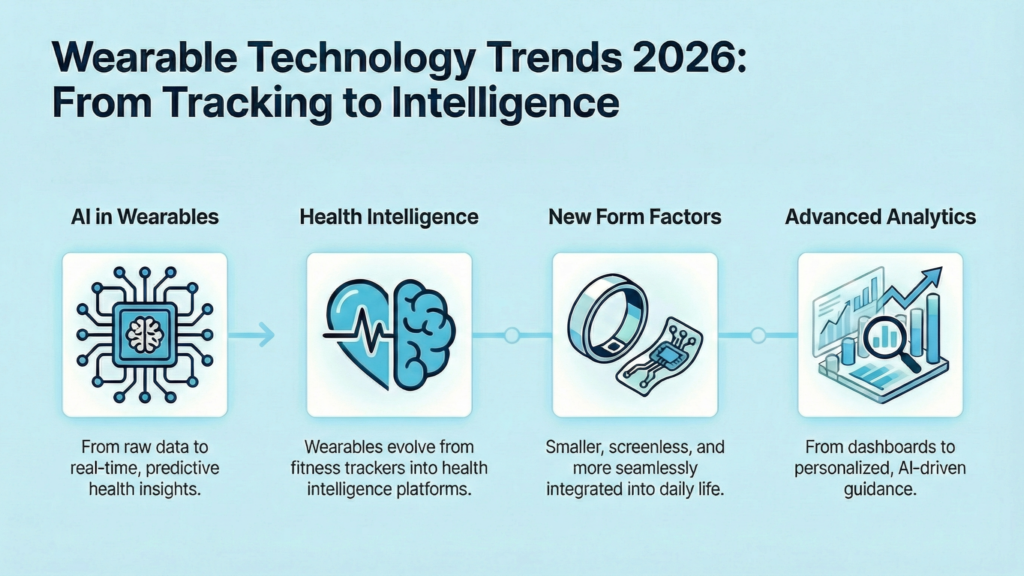
At the core of all four trends is a single catalyst: artificial intelligence. The evolution from tracking devices to intelligent systems begins here, with AI reshaping how wearables generate insight, deliver guidance, and adapt to the user—making it the natural starting point for the innovations and showcases explored below.
Trend #1. AI in Wearables—Reshaping User Experience From Metrics to Meaning
For more than a decade, wearables have focused on measurement: steps, heart rate, calories, sleep stages, and training load. While this data has become increasingly accurate, its practical value has often remained limited. Users are presented with dashboards, graphs, and scores, but must still interpret what any of it means for their health, recovery, or performance.
At CES 2026, a decisive shift became evident: wearables are no longer designed merely to collect data—they are being engineered to interpret it, contextualize it, and act on it. Artificial intelligence is now embedded directly into devices and platforms, transforming raw physiological signals into insights, recommendations, and, increasingly, autonomous responses.
This marks a structural transition:
- From quantification → to cognition
- From tracking behavior → to supporting decision-making
- From user-led interpretation → to machine-assisted understanding
In short, AI is repositioning wearables as intelligent companions, not passive sensors.
Within this macro shift, CES 2026 revealed three architectural innovations that collectively define how “AI wearables” now operate as explained in the sections below.
1. On-Device Intelligence and Edge AI
Instead of sending all sensor data to the cloud for processing, new-generation wearables perform analysis directly on the device. This enables:
- Lower latency for real-time feedback
- Improved privacy and data sovereignty
- Reduced dependence on continuous connectivity
Edge AI transforms wearables from “data loggers” into local decision engines capable of immediate interpretation.
2. From Raw Data to Real-Time Health Guidance
Historically, wearable analytics asked users to draw conclusions from dashboards. CES 2026 revealed a decisive move away from that model. AI is now being used to transform continuous data streams into predictive, actionable health guidance.
Rather than displaying metrics alone, AI systems synthesize multi-sensor inputs into actionable guidance. This includes:
- Context-aware alerts (e.g., stress, fatigue, or cognitive overload)
- Predictive insights based on longitudinal trends
- Personalized recommendations that adapt over time
The wearable is no longer asking, “Here is your data—what will you do with it?”
It is now saying, “Here is what this means, and here is what to do next.”
3. Voice, Context, and Passive Interaction
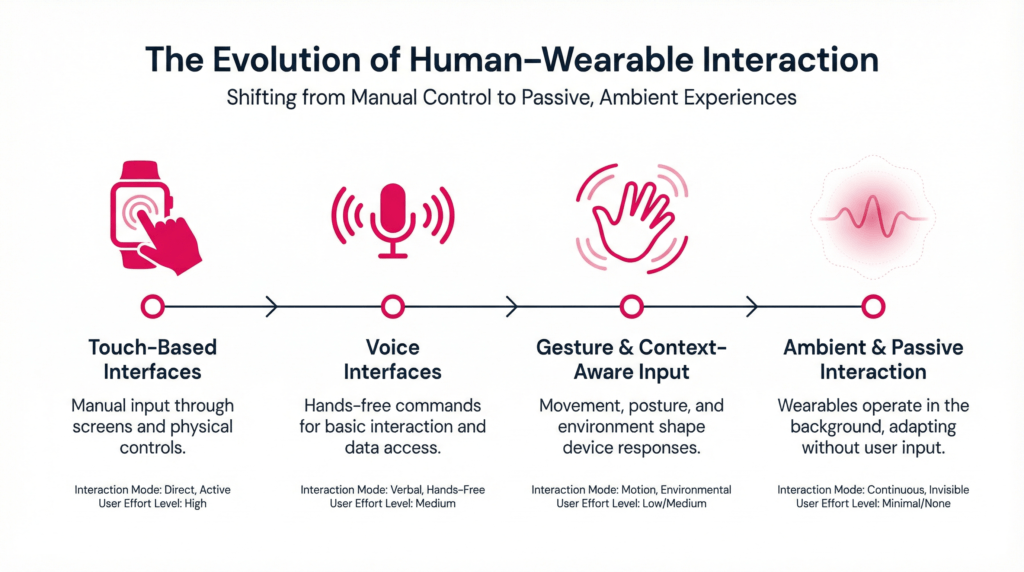
CES 2026 also highlighted the growing importance of context-aware and screenless wearables. Voice-driven interaction, ambient feedback, and passive sensing are reducing friction between the user and the technology, thereby redefining how users interact with wearables:
- Voice interfaces replace screens
- Context awareness enables proactive responses
- Haptics and ambient cues deliver feedback without demanding attention
This shift supports screenless or low-friction use, making intelligence available continuously rather than only when a user opens an app.
For athletes and professionals alike, this represents a meaningful improvement in how health data is consumed: not as a distraction, but as an embedded layer of guidance.
Trend #2. Health-First Wearables—From Fitness Tracking to Human Performance
For much of the past decade, wearable technology has been shaped by a fitness-centric worldview: counting steps, logging workouts, optimizing training load, and quantifying calories burned. While this model successfully drove mass adoption, it framed human health primarily through the lens of activity rather than physiology.
CES 2026 revealed a pivotal reframing of this paradigm. Wearables are no longer designed simply to optimize performance in the gym—they are increasingly built to support the body as a complex biological system. The focus has expanded from exercise metrics to recovery, stress, sleep quality, cognitive function, emotional regulation, and long-term resilience.
In effect, the industry is shifting:
- From fitness tracking → to health intelligence
- From short-term performance metrics → to continuous physiological optimization
- From reactive monitoring → to preventive and adaptive intervention
Rather than asking, “How active are you?” today’s health-first wearables are beginning to ask:
“How is your body functioning, adapting, and recovering over time?”
This transition reflects broader changes in healthcare, sports science, and workplace performance, where the priority is no longer just output—but sustainability, resilience, and human capacity under real-world conditions.
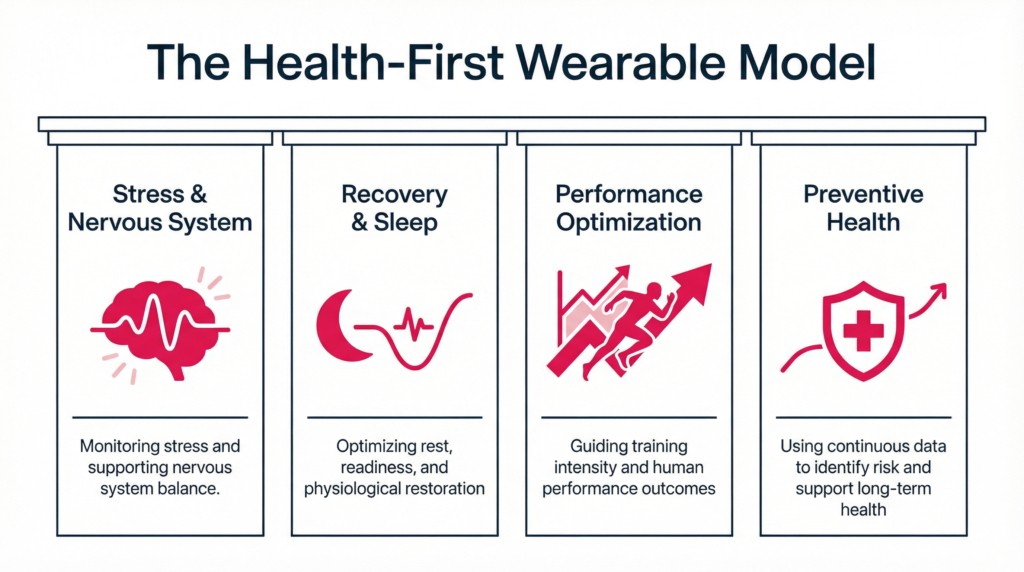
1. Stress, Recovery, and Nervous System Support
A defining trend at CES 2026 was the expansion of wearable technology into stress regulation, recovery optimization, and nervous system awareness.
Where traditional devices focused primarily on physical activity, newer systems aim to interpret physiological load—how the body and mind respond to training, work, and lifestyle stressors. Metrics such as heart rate variability, sleep architecture, and autonomic balance are being used to guide recovery strategies, breathing practices, and rest intervals.
This shift reframes wearables from fitness gadgets into human performance tools, supporting both physical output and cognitive resilience.
2. Continuous Monitoring and Preventive Health
Another major development is the growth of continuous health monitoring as a foundation for preventive care. Rather than capturing isolated snapshots, modern wearables collect longitudinal data that reveals trends over weeks and months.
This enables early detection of deviations in baseline health patterns—changes in sleep quality, stress response, or cardiovascular markers that may indicate overtraining, fatigue, or emerging health risks.
For users, this transforms wearables into early-warning systems, supporting proactive intervention rather than reactive treatment.
3. Personalized Health at Scale
CES 2026 also underscored the role of adaptive algorithms and behavioral insights in personalizing health experiences. AI systems now adjust recommendations based on individual physiology, habits, training history, and lifestyle context.
This personalization is critical. Two people can follow identical training plans yet respond very differently. AI-powered wearables acknowledge this reality, tailoring guidance to the individual rather than the average user.
The result is a shift from generalized fitness advice to precision health technology.
Trend #3. New Form Factors—Smart Rings, Screenless Devices, and the Future of Wearable Design
For much of the wearable era, innovation has been defined by a single dominant form factor: the smartwatch. While watches accelerated mainstream adoption, they also imposed structural limitations—screens demanded attention, interactions required deliberate engagement, and wearables often felt like devices to be checked rather than systems that quietly worked in the background.
CES 2026 made one reality unmistakably clear: the future of wearables is not bound to the wrist, nor to the screen. A new generation of devices is emerging that prioritizes invisibility, continuity, and low-friction integration into daily life. Smart rings, pendants, patches, and screenless AI companions are redefining what it means to “wear” technology.
This represents a fundamental design transition:
- From screen-first interfaces → to ambient, context-driven interaction
- From devices that demand attention → to systems that operate passively
- From visible gadgets → to integrated, unobtrusive form factors
Rather than asking users to adapt to technology, next-generation wearables are being designed to adapt to the user’s body, environment, and routines.
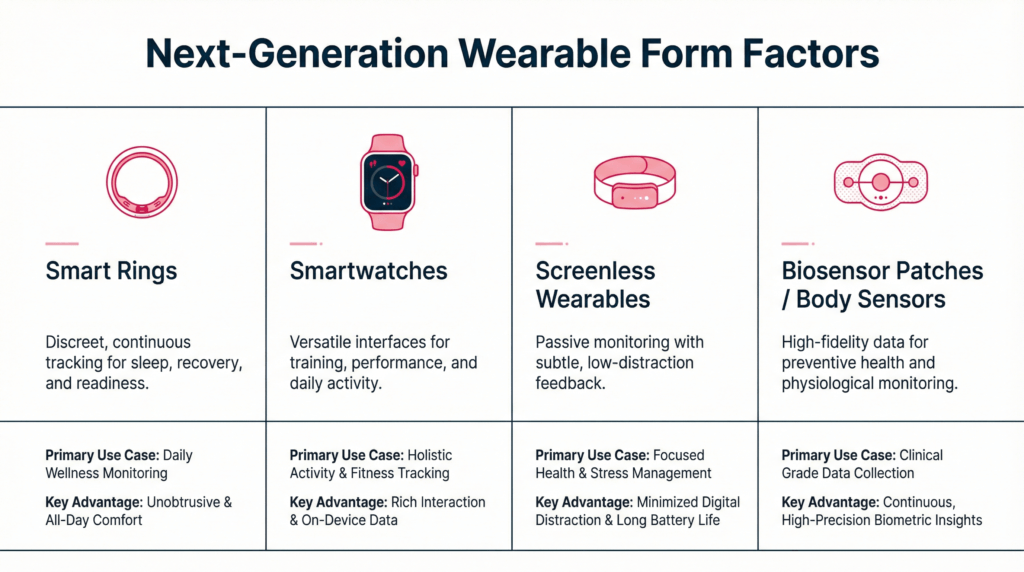
Below are the key innovations that explain how new form factors are redefining wearable design, interaction, and adoption.
1. From Wrist-Centric Devices to Distributed Wearables – Smart Rings & Body-Integrated Technologies
For over a decade, the smartwatch has dominated the category, concentrating sensing, processing, and interaction on a single form factor. CES 2026 revealed a decisive expansion beyond the wrist into distributed wearable ecosystems.
This includes:
- Smart rings for continuous biometric monitoring
- Pendants, clips, and patches for passive sensing and context capture
- Body-adjacent sensors embedded into clothing or accessories
Rather than relying on one device to do everything, the new paradigm distributes functions across multiple, specialized form factors—each optimized for comfort, signal quality, and use context.
The wearable is no longer a single object.
It is becoming a network of body-integrated interfaces.
2. Screenless and Ambient Interaction
Screens have historically defined how users engage with wearables, but they also introduce friction: attention demands, battery drain, and visual fatigue. CES 2026 showcased a shift toward screenless or minimal-display interaction models.
Key interaction modalities include:
- Voice-first interfaces for hands-free control and guidance
- Haptic feedback to deliver alerts without interruption
- Context-aware automation, where the device acts based on environment, behavior, or physiological state
This innovation layer reframes the wearable as an ambient system—one that delivers value continuously without requiring conscious interaction.
The experience moves from:
“Checking a device”
to
“Being supported by an environment of intelligence.”
3. Ergonomics, Comfort, and Long-Term Wearability as Core Design Criteria
As wearables expand from workouts into all-day and overnight use, comfort and ergonomics become foundational—not secondary—design priorities. CES 2026 highlighted a new emphasis on wearables that users can forget they are wearing.
This includes:
- Lightweight materials and compact electronics
- Skin-safe, breathable, and hypoallergenic surfaces
- Form factors that accommodate sleep, work, and daily life without disruption
This design philosophy enables:
- Longer continuous data collection
- Higher user compliance
- Greater integration into health and performance workflows
Wearables are being engineered not just to be functional, but to be physically and cognitively invisible.
4. Fashion-Integrated and Lifestyle-Native Design
CES 2026 also underscored that adoption at scale depends on aesthetic and cultural integration, not only technical capability. New form factors increasingly treat fashion and lifestyle compatibility as functional requirements.
Key developments include:
- Devices designed to resemble jewelry, accessories, or apparel
- Customizable finishes and modular components
- Form factors that align with personal identity rather than “tech gadget” signaling
This layer transforms wearables from niche technology into mainstream lifestyle objects, enabling broader acceptance across demographics that have historically resisted visible tech.
Trend #4. From Tracking to Intelligence—The Rise of Wearable Analytics
For most of their history, wearables have functioned as data collection tools. They measured heart rate, movement, sleep stages, and activity patterns, presenting the information in dashboards that quantified what had already happened. While this enabled self-awareness, it left the burden of interpretation squarely on the user.
CES 2026 revealed a decisive evolution: wearables are no longer just tracking the body—they are beginning to understand it. Advanced analytics, machine learning, and longitudinal modeling are transforming streams of sensor data into coherent narratives about health, performance, and risk.
This marks a structural shift:
- From retrospective reporting → to predictive and adaptive insight
- From isolated metrics → to systems-level physiological understanding
- From data presentation → to intelligence generation
Instead of asking, “What happened?” wearable analytics are now increasingly designed to answer:
“What is happening inside the body—and what is likely to happen next?”
Below are the key innovations that explain how wearable analytics is evolving from simple tracking into true intelligence.
1. From Snapshot Measurement to Continuous Health Modeling
Traditional wearables capture the body in moments—a workout, a night of sleep, a resting heart rate reading. While useful, these snapshots fail to represent how the body behaves as a dynamic, adaptive system.
At CES 2026, next-generation analytics platforms demonstrated a shift toward continuous modeling, where physiological signals are monitored and interpreted across hours, days, and months.
This enables:
- Detection of subtle trends rather than isolated anomalies
- Differentiation between temporary fluctuations and structural change
- Personalized baselines that evolve with training, stress, aging, and lifestyle
The wearable no longer asks, “What is your heart rate right now?”
It asks, “How is your body changing over time—and what does that trajectory mean?”
2. Multi-Signal Fusion and Systems-Level Physiology
Earlier wearable analytics treated metrics as independent variables: heart rate here, sleep there, activity somewhere else. CES 2026 highlighted a new analytical paradigm—multi-signal fusion—in which data streams are interpreted together as part of a unified biological system.
Advanced platforms now correlate:
- Heart rate, HRV, and respiration
- Sleep architecture and recovery markers
- Movement patterns, workload, and stress indicators
This approach enables:
- More accurate identification of fatigue, overtraining, and stress accumulation
- Contextual interpretation (e.g., elevated heart rate during illness vs. exercise)
- A shift from surface metrics to deep physiological insight
Rather than reporting numbers, wearables are beginning to model how systems interact inside the body.
3. Predictive and Risk-Based Health Analytics
CES 2026 also marked a move beyond descriptive analytics into predictive intelligence. Instead of telling users what already happened, analytics engines are increasingly designed to anticipate what is likely to occur next.
This includes:
- Forecasting recovery needs based on accumulated load
- Identifying early deviations linked to stress, illness, or burnout
- Flagging long-term risk patterns before symptoms emerge
These systems transform wearables from retrospective tools into early-warning platforms, supporting:
- Preventive health strategies
- Adaptive training and workload management
- Data-informed lifestyle and recovery decisions
The value of the wearable is no longer in reporting performance—it is in protecting future capacity.
4. Insight-Driven Interfaces and Decision Support
As analytics become more sophisticated, CES 2026 demonstrated a corresponding shift in how insight is delivered. Rather than dashboards filled with charts, next-generation systems prioritize decision-oriented outputs.
Key characteristics include:
- Clear, outcome-based summaries instead of metric overload
- Context-aware recommendations grounded in longitudinal data
- Integration with AI systems that translate complex analytics into simple actions
The user experience moves from:
“Here is your data.”
to
“Here is what matters right now—and why.”
This layer ensures that advanced analytics produce practical, human-centered value, not just technical sophistication.
What CES 2026 Trends Signal About the Next Decade of Wearable Technology
The Wearable Tech Innovation Roadmap
The long-term trajectory is clear: wearables are converging with digital health platforms, AI systems, and sensor ecosystems to form integrated health intelligence networks.
Key directions include:
- Deeper interoperability with healthcare systems and wellness platforms
- Increased reliance on on-device intelligence
- Expansion of preventive and longitudinal health analytics
- More personalized, context-aware user experiences
Wearables are becoming foundational components of consumer health technology.
Market Implications for Brands, Athletes, and Health Professionals
For manufacturers, success will depend less on hardware differentiation and more on:
- Quality of AI interpretation
- Depth of health insights
- Trust, privacy, and data security
- Ecosystem integration
For users, expectations will shift toward devices that explain, guide, and adapt, rather than merely measure.
How to Evaluate AI-Driven Wearables in 2026
As wearable technology grows more sophisticated, selecting the right device requires a new evaluation framework.
Key Buying and Evaluation Criteria
When assessing next-generation wearables, consider:
- Intelligence Depth: Does the device provide actionable insights or only raw metrics?
- Sensor Quality: Are biometric measurements reliable and clinically meaningful?
- Processing Model: Is AI performed on-device for privacy and speed?
- Battery Efficiency: Can it sustain continuous monitoring without frequent charging?
- Privacy and Data Control: How is personal health data stored and managed?
- Ecosystem Integration: Does it connect effectively with training platforms, health apps, or professional workflows?
Devices that excel across these dimensions will define the future of fitness and health wearables.
Frequently Asked Questions About CES 2026 Wearable Trends
Looking Ahead Beyond CES 2026: The Wearable as a Health Intelligence Platform
CES 2026 made one thing unmistakably clear: wearables are transitioning from tracking devices into health intelligence platforms. Artificial intelligence, advanced sensors, and new form factors are redefining how people understand their bodies, manage performance, and protect long-term wellbeing.
The next era of wearable technology will not be measured by the number of metrics collected, but by the quality of insights delivered—and by how seamlessly those insights fit into everyday life.
At WearableFitnessTech.com, our mission is to interpret this evolution: translating innovation into practical understanding for athletes, professionals, and anyone committed to optimizing health through technology. The future of wearables is not just smarter devices. It is smarter humans, supported by intelligent systems designed around real human needs.
Continue Exploring
Deepen Your Understanding of Wearable Technology
Build on the CES 2026 insights with in-depth analysis across wellness technology, real-world health benefits, and the evolving landscape of wearable data privacy.