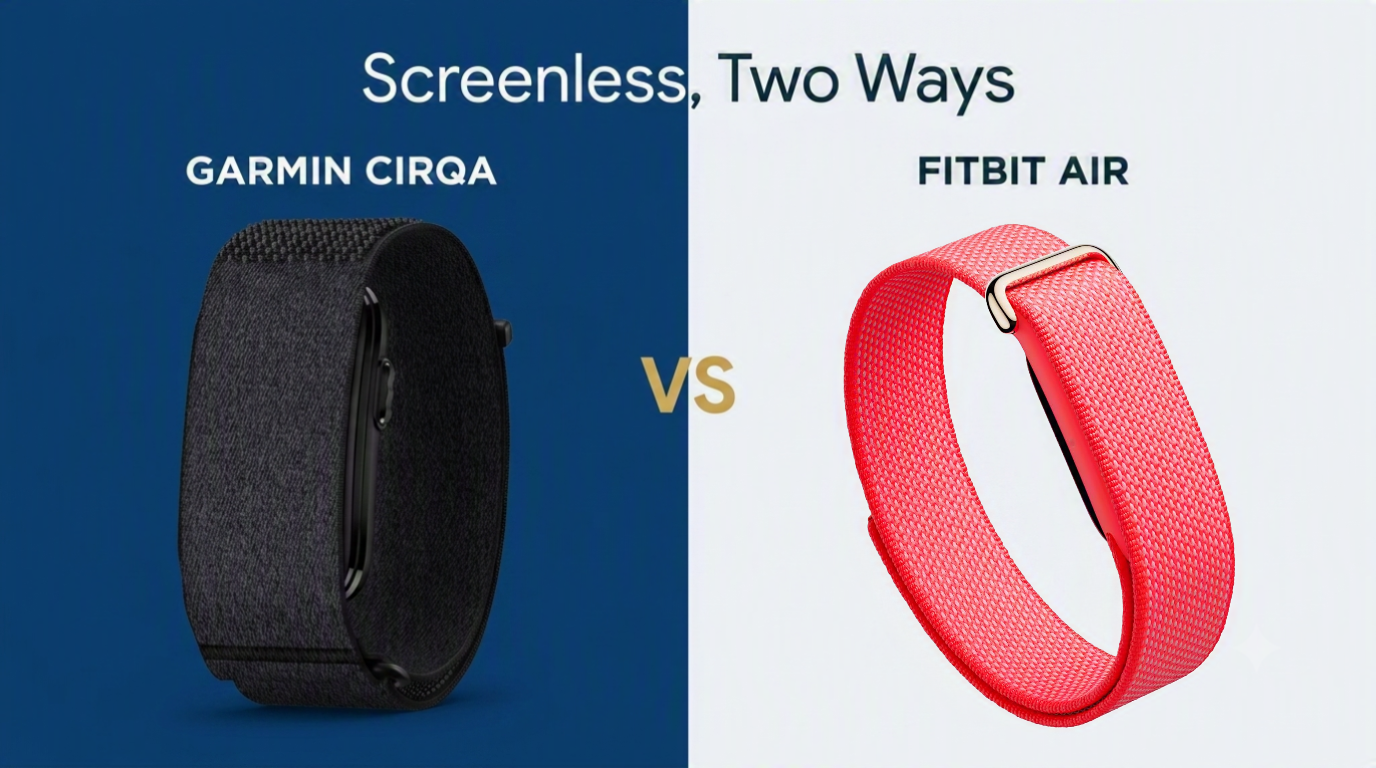
Garmin CIRQA and Fitbit Air pursue the same big idea: collect meaningful health and fitness data without putting another screen, notification feed or smartwatch interface on your wrist.
The two bands take very different routes to that goal.
At $99.99, Google Fitbit Air is the smaller, lighter and more affordable option. It emphasizes comfortable 24/7 wear, sleep and everyday health monitoring, heart-rhythm alerts, optional coaching built with Gemini and offers up to 7 days of battery life.
At $199.99, Garmin CIRQA Smart Band costs twice as much upfront. In return, it offers up to 10 days of battery life, a physical workout button, more than 80 activity profiles and deeper Garmin training tools such as Body Battery, Training Readiness, Training Status and VO2 max—all without requiring a subscription for the core experience.
Neither device has a display or built-in GPS. Both rely on a phone app for detailed insights, and both offer optional paid services that expand their coaching or AI capabilities.
So which should you buy? Fitbit Air is the stronger value for wellness-focused users who prioritize comfort, simplicity and Google’s AI-assisted experience. Garmin CIRQA is the more capable option for active users—especially existing Garmin owners—who want deeper training and recovery data without a mandatory membership.
WFT preliminary verdict: Choose Fitbit Air if price, comfort and everyday wellness are your priorities. Choose Garmin CIRQA if training depth, battery life and Garmin ecosystem continuity matter more. This comparison is based on confirmed specifications, official documentation and WFT’s existing Fitbit Air analysis. WFT has not yet completed side-by-side hands-on testing, so sensor accuracy and real-world comfort remain open questions.
Garmin CIRQA vs Fitbit Air: quick comparison
| Feature | Garmin CIRQA | Google Fitbit Air | Early advantage |
|---|---|---|---|
| US price | $199.99 | $99.99 | Fitbit Air |
| Screen | None | None | Tie |
| Battery claim | Up to 10 days | Up to 7 days | CIRQA |
| Quick charging | Up to 90 minutes for a full charge | One day in 5 minutes; up to 90 minutes for a full charge | Fitbit Air |
| Built-in GPS | No | No | Tie |
| Connected phone GPS | Yes | Phone-dependent activity location features | Tie |
| Activity tracking | More than 80 profiles, automatic detection and manual start | Automatic detection, app-started and manual logging | CIRQA |
| On-band workout control | Single physical button for a favorite activity | No comparable physical workout button | CIRQA |
| Recovery tools | Body Battery, Training Readiness, HRV Status, Training Status and recovery insights | Readiness Score, Cardio Load and daily target | CIRQA for depth |
| AI coaching | Active Intelligence through optional Connect+ | Google Health Coach built with Gemini through Health Premium | Fitbit Air |
| Heart-rhythm feature | High/low heart-rate alerts; no confirmed AFib feature | Irregular rhythm monitoring with AFib alerts, subject to eligibility and regional availability | Fitbit Air |
| SpO2 | Yes | Yes | Tie |
| Skin temperature | Yes | Yes | Tie |
| Sleep tracking | Sleep Score, stages, naps, HRV, respiration and Sleep Coach | Sleep Score, stages, duration and coaching through Google Health | Depends on preferred ecosystem |
| Water resistance | 5 ATM | Water resistant to 50 metres | Tie |
| Wear locations | Wrist or upper arm with compatible band | Wrist | CIRQA |
| Module weight | Heavier and larger than Fitbit Air | 5.2 g without band; approximately 12 g with band | Fitbit Air |
| Phone compatibility | Garmin Connect on compatible iOS and Android phones | Android 11+ and iOS 16.4+ | Tie for most users |
| Core subscription required | No | No | Tie |
| Optional paid service | Connect+: $6.99/month or $69.99/year in the US | Google Health Premium: $9.99/month in the US | CIRQA costs less if adding premium service |
Prices, subscriptions, eligibility and feature availability can vary by country and may change. Manufacturer battery claims are not directly equivalent to WFT real-world testing.
The short answer: which one should you buy?
Buy Garmin CIRQA if:
- You already use a Garmin watch, bike computer or Garmin Connect
- You want Body Battery, Training Readiness and Training Status
- You regularly record structured exercise
- You want to start a favorite activity without opening your phone
- You want up to 10 days of battery life
- You want the option to wear the sensor on your upper arm
- You want deeper training data without a required annual membership
Buy Fitbit Air if:
- You want the lower-cost option
- You prioritize a small, lightweight band for sleep and continuous wear
- You want irregular heart-rhythm monitoring and AFib alerts where available
- You prefer Google Health and Fitbit’s wellness-oriented presentation
- You want conversational health, fitness and sleep guidance built with Gemini
- You already use a Pixel Watch and want a lighter overnight companion
- You are new to wearables and do not need Garmin’s more technical training tools
Price and long-term cost
Fitbit Air’s $99.99 starting price is its clearest advantage. It costs half as much as the $199.99 Garmin CIRQA, making it more accessible to first-time tracker buyers and people who mainly want passive health, sleep and activity monitoring.
Both devices work without a paid subscription, but the premium layer changes the long-term calculation.
Garmin Connect+ costs $6.99 per month or $69.99 per year in the US. It adds features such as Active Intelligence, richer dashboards and compatible premium experiences. CIRQA’s core health, sleep and training metrics remain available through the free Garmin Connect experience.
Google Health Premium costs $9.99 per month in the US after the included three-month trial. It unlocks Google Health Coach, which uses Gemini to provide adaptive fitness, sleep and wellness guidance. Google AI Pro and Ultra subscribers may receive Health Premium as part of their existing plan in supported markets.
Approximate US ownership cost
| Scenario | Year one | Two years |
| CIRQA without Connect+ | $199.99 | $199.99 |
| CIRQA with annual Connect+ | $269.98 | $339.97 |
| Fitbit Air without Health Premium | $99.99 | $99.99 |
| Fitbit Air with Health Premium after the included three-month trial | About $189.90 | About $309.78 |
These estimates exclude taxes, replacement bands, promotions and regional pricing. They also assume the current annual Garmin price and monthly Google price remain unchanged.
Winner: Fitbit Air. It remains cheaper whether or not you subscribe, although the difference narrows if both premium services are maintained over several years.
Design, size and overnight comfort
Fitbit Air is the more discreet device. Its module measures 34.9 × 17 × 8.3 mm and weighs 5.2 g without the band or approximately 12 g with the standard band. Its narrow profile is a meaningful advantage for small wrists, sleep tracking and users who want to forget that they are wearing a device.
CIRQA is visibly broader and heavier, although still designed as a low-profile screenless band. Garmin uses a 24 mm fabric strap, while the module can be moved between compatible wrist and upper-arm bands. The upper-arm option may be useful for strength training, activities where wrist movement interferes with optical heart-rate tracking, or people who prefer to keep both wrists free.
Both standard models use adjustable fabric bands. Garmin says the CIRQA fabric band can be machine washed after removing the sensor module. Fitbit recommends fully drying the band after sweat or water exposure and offers textile, silicone and more fashion-oriented accessory styles.
Fitbit Air’s smaller hardware gives it the advantage on paper, but comfort is personal. Band tension, drying time, skin sensitivity and stability during exercise can matter more than a few millimetres.
Winner: Fitbit Air for minimal size and likely sleep comfort. CIRQA wins for wear-location flexibility.
Health monitoring: similar foundations, one important Fitbit advantage
Both trackers cover the core signals expected from a modern screenless health band:
- Continuous optical heart rate
- Resting heart rate
- Heart rate variability
- SpO2 estimates
- Respiration or breathing rate
- Skin-temperature trends
- Daily activity, steps and calories
- Stress and recovery-related insights
The important distinction is heart-rhythm monitoring. Fitbit Air can monitor heart rhythm while the user is still or sleeping and look for signs of atrial fibrillation. Eligibility restrictions apply, and the feature is not available in every country. CIRQA offers abnormal high- and low-heart-rate alerts, but Garmin does not list an equivalent AFib-detection feature for CIRQA.
Garmin counters with Health Status, Body Battery and a more interconnected view of wellness and training stress. These features can help active users see whether overnight measurements are within their personal range and how sleep, stress and activity may be affecting available energy.
Neither product is a medical device, and SpO2, temperature, stress and recovery estimates should not be used to diagnose or treat a condition. WFT also cannot declare one sensor system more accurate until comparable testing is available.
Winner: Fitbit Air for AFib alerts; CIRQA for Garmin’s broader wellness-and-training context.
Sleep tracking and recovery
Both devices are designed to be worn overnight, but their approach differs.
CIRQA records sleep stages, Sleep Score, naps, overnight HRV, respiration, skin temperature and Pulse Ox when enabled. Garmin’s Sleep Coach recommends a sleep duration, while Body Battery and Training Readiness incorporate sleep and other physiological inputs into daily recovery guidance.
Fitbit Air records sleep duration, stages and Sleep Score, along with overnight health metrics. Its smaller form factor may encourage more consistent use, which is essential because even the best sleep algorithm cannot compensate for nights when the device is sitting on a charger.
Google’s differentiator is the optional Health Coach. Rather than only presenting a score, the Gemini-powered coach can discuss sleep goals, offer day-by-day suggestions and adjust guidance when travel, disrupted routines or other circumstances change.
Garmin is stronger for users who want sleep interpreted in the context of training readiness and accumulated load. Fitbit Air is more approachable for users who want sleep and wellness guidance explained conversationally.
Winner: CIRQA for performance-oriented recovery; Fitbit Air for approachable AI-assisted sleep guidance and lower-profile wear.
Fitness tracking and workout control
This is where CIRQA creates the most distance.
Garmin supports more than 80 activity profiles, including running, cycling, swimming, strength, HIIT, hiking, yoga, team sports, racket sports and winter activities. Activities can be detected automatically, started from Garmin Connect or assigned to the band’s single physical button.
That button matters more than it sounds. A screenless device normally forces the user to find a phone before a workout. CIRQA lets the user press once to begin a preferred activity and press again to stop it, with LED and vibration feedback confirming the action.
Fitbit Air can automatically detect common workouts, start an activity through Google Health or log one manually. The automatic detection is designed to improve through personalization. With Health Premium, Google Health Coach can also recommend guided workouts and interpret a photographed gym routine or cardio machine.
Fitbit Air still covers everyday exercise well, but CIRQA offers a more established multisport framework and more control over intentional workout recording.
Winner: Garmin CIRQA.
Training readiness and performance analytics
Fitbit Air is not limited to basic steps and sleep. It offers Cardio Load and Readiness Score, then provides a daily target intended to help balance effort and recovery.
CIRQA goes further into Garmin’s performance system with:
- Training Readiness
- Training Status
- HRV Status
- VO2 max
- Body Battery
- Recovery insights
- Workout-effectiveness analysis
- Intensity minutes
- Fitness Age
- Unified Training Status across compatible Garmin devices
These tools are especially useful for people already recording runs, rides or other structured training in Garmin Connect. CIRQA can function as the continuous-monitoring part of a larger Garmin setup while a Forerunner, Fenix or Edge records the detailed workout.
The trade-off is complexity. Garmin Connect presents more metrics and terminology, while Fitbit’s approach is easier for many general wellness users to understand. More data is only better if the user knows how to act on it.
Winner: Garmin CIRQA for depth; Fitbit Air for simplicity.
AI coaching: Google Health Coach versus Garmin Active Intelligence
Fitbit Air was designed as an entry point to Google Health Coach. The coach, built with Gemini, can use health and activity information to provide fitness plans, sleep suggestions and guidance that adapts to the user’s progress and circumstances.
This is a compelling proposition for someone who wants to ask questions rather than interpret several dashboards. It is also a paid proposition: Google Health Coach requires Health Premium after the trial unless it is included through another eligible Google subscription.
Garmin offers Active Intelligence through Connect+. It surfaces personalized observations based on health and activity data, but Garmin’s core strength remains its structured metrics and established training ecosystem rather than a conversation-first coaching interface.
For users who want an AI coach to translate their data into plain-language suggestions, Fitbit Air has the clearer advantage. Users who already understand Training Readiness, HRV Status and Training Status may not need to pay for either AI layer.
Winner: Fitbit Air.
Battery life and charging
Garmin advertises up to 10 days for CIRQA. Fitbit Air is rated for up to seven days.
Fitbit responds with better-defined fast charging: five minutes can provide up to one day of use, while a complete charge takes around 90 minutes. Garmin’s manual also says CIRQA can take up to 90 minutes to charge, but Garmin emphasizes the longer interval between charges rather than a five-minute endurance claim.
Real battery life will depend on settings and usage. Frequent workouts, Pulse Ox monitoring, automatic activity detection and Bluetooth synchronization can reduce endurance. Garmin’s Battery Saver also disables several central tracking functions, so its extended-life mode should not be treated as equivalent to normal use.
Winner: CIRQA for maximum claimed endurance; Fitbit Air for documented quick charging.
GPS and phone dependence
Neither CIRQA nor Fitbit Air has built-in GPS. Users seeking mapped routes and location-based distance for outdoor workouts should expect to carry a paired phone.
That limitation is more consequential for CIRQA because Garmin’s brand is closely associated with GPS sports devices. CIRQA can record running and cycling, but it is not a screenless Forerunner: it cannot independently provide on-wrist maps, navigation or live pace.
Both devices also require their companion apps for detailed data. CIRQA uses Garmin Connect, while Fitbit Air uses Google Health. The absence of a display reduces distraction, but it also transfers interaction to the phone.
Winner: Tie.
Water resistance and swimming
CIRQA is rated to 5 ATM, and Fitbit Air is described as water resistant to 50 metres. Both can therefore serve as fitness trackers for swimming and routine water exposure within their manufacturers’ guidance.
The standard fabric bands introduce a practical issue: they must be kept clean and allowed to dry. Fitbit offers an optional silicone Active Band, while Garmin’s removable fabric band can be machine washed without the sensor module.
Water resistance is not permanent, and a depth rating does not automatically mean a device is suitable for scuba diving or high-speed water sports.
Winner: Tie on device rating. Band preference may decide it.
Ecosystem: the decision many buyers should make first
The best choice may be determined before comparing individual sensors.
CIRQA fits best in a Garmin Ecosystem
Garmin users can keep data within Garmin Connect and combine CIRQA with compatible watches and cycling computers. An athlete could wear CIRQA for sleep and daily monitoring, then use a Forerunner or Edge for detailed GPS training. Unified Training Status is intended to help compatible devices contribute to one training picture.
Fitbit Air fits best in Google Health Ecosystem
Fitbit Air works with Android and iOS, but its deeper value comes from Google Health, Google Health Premium and the wider Pixel ecosystem. Google specifically positions Air as a lightweight overnight companion to Pixel Watch, allowing users to switch devices without abandoning continuity.
If years of historical data, familiar dashboards and connected devices already live in one ecosystem, switching may create more friction than any single hardware advantage can justify.
Winner: Whichever ecosystem you already use.
Final verdict: Garmin CIRQA or Fitbit Air?
Garmin CIRQA is the better screenless fitness and performance tracker. Its advantages—longer claimed battery life, a physical activity button, more than 80 sports profiles, upper-arm wear and deeper readiness and training metrics—justify the higher price for active users who will use them.
Fitbit Air is the better affordable screenless wellness tracker. It is smaller, lighter and half the price, while still covering sleep, daily readiness, Cardio Load, SpO2, temperature trends and irregular heart-rhythm monitoring. Its optional Gemini-powered coach also makes complex health data more approachable.
WFT recommendation
- Best for existing Garmin users: Garmin CIRQA
- Best for serious recreational training: Garmin CIRQA
- Best for first-time wearable buyers: Fitbit Air
- Best for sleep comfort and smaller wrists: Fitbit Air
- Best for AFib alerts: Fitbit Air, where eligible and available
- Best for training metrics without a mandatory subscription: Garmin CIRQA
- Best for conversational AI coaching: Fitbit Air with Google Health Premium
- Best overall value: Fitbit Air
- Best overall capability: Garmin CIRQA
The decisive question is not simply whether you want a screenless band. It is whether you want that band to behave primarily like a quiet wellness companion or a screenless extension of a performance ecosystem.
Fitbit Air is the quieter, cheaper wellness companion. CIRQA is the more capable training extension.
Frequently asked questions
Is Garmin CIRQA better than Fitbit Air?
CIRQA is better for training metrics, activity profiles, battery life and integration with other Garmin devices. Fitbit Air is better for affordability, minimal size, AFib alerts and Google’s conversational health coaching. The better option depends on the user’s priorities.
Why does Garmin CIRQA cost more than Fitbit Air?
CIRQA includes deeper Garmin training and recovery tools, more than 80 activity profiles, a physical workout button, upper-arm compatibility and up to 10 days of battery life. Fitbit Air prioritizes affordable, lightweight wellness monitoring.
Do CIRQA and Fitbit Air require subscriptions?
No. Both provide core tracking without a paid membership. Garmin Connect+ adds Active Intelligence and other premium experiences, while Google Health Premium adds the Gemini-powered Google Health Coach and deeper guidance.
Which has better battery life?
Garmin advertises up to 10 days for CIRQA, compared with up to seven days for Fitbit Air. Actual battery life varies with settings and usage and should be verified through side-by-side testing.
Do either of them have built-in GPS?
No. Both depend on a compatible phone for GPS-enabled route and location information.
Which is better for sleep tracking?
Fitbit Air’s smaller, lighter design may be more comfortable for sleep. CIRQA provides deeper performance-oriented recovery context through Body Battery and Training Readiness. Accuracy cannot be compared conclusively without controlled testing.
Which is better for runners?
CIRQA provides more training metrics and workout profiles, making it the stronger companion tracker for runners. Neither has built-in GPS, so runners who train without a phone should consider a GPS running watch instead.
Can I wear CIRQA or Fitbit Air while swimming?
Yes. CIRQA has a 5 ATM rating and Fitbit Air is water resistant to 50 metres. Follow the manufacturers’ guidance and dry the band after water exposure.
Does Fitbit Air detect AFib?
Fitbit Air can monitor heart rhythm while the user is still or sleeping and issue irregular-rhythm notifications that may indicate AFib. Age, health and regional eligibility requirements apply, and the feature is not a medical diagnosis.
Can CIRQA work alongside a Garmin watch?
Yes. CIRQA appears particularly suited to filling daily and overnight tracking gaps when a Garmin watch is removed. The behavior of preferred-device settings and overlapping data should still be evaluated through real-world testing.
Still deciding? Read our complete Garmin CIRQA launch explainer for a deeper look at Garmin’s new screenless fitness band, or explore our Fitbit Air review for WFT’s full assessment of Google’s screenless wellness tracker.