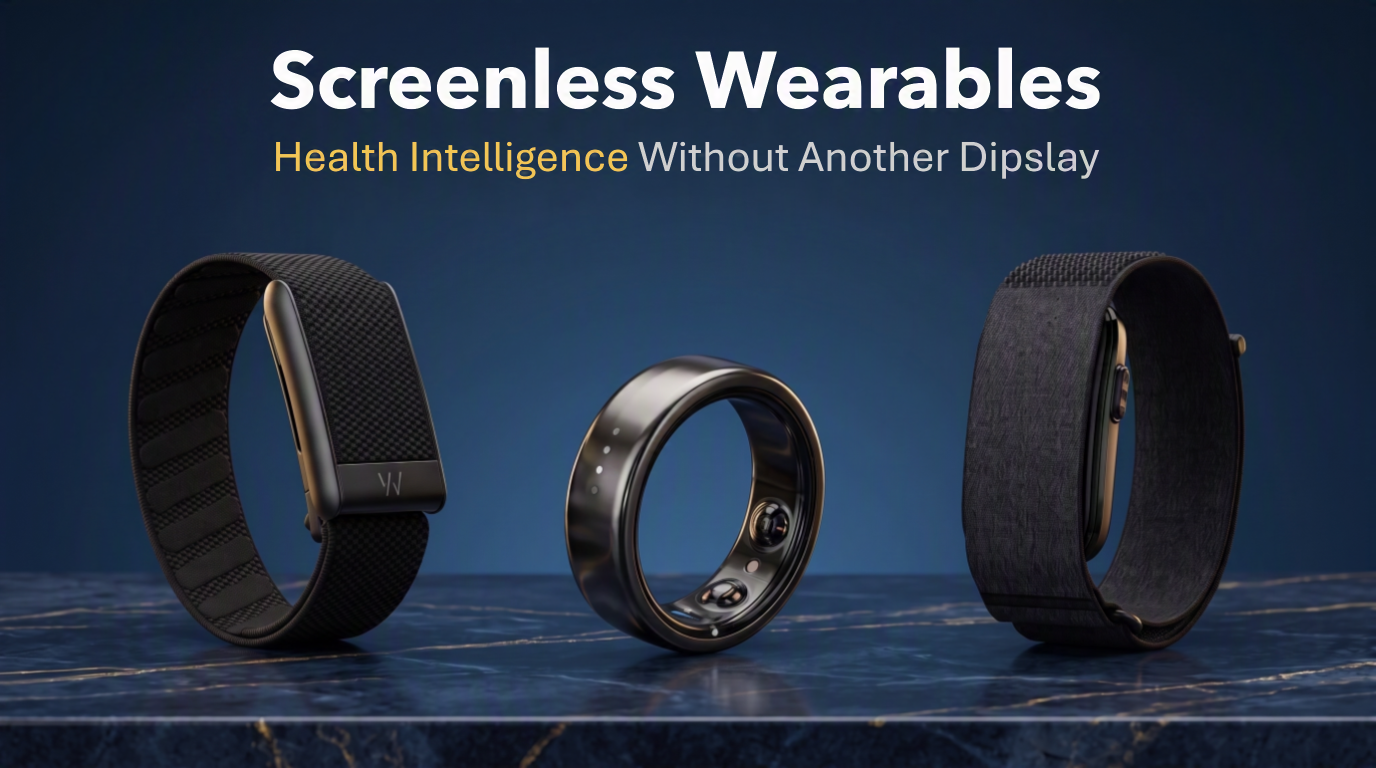
Wearable technology spent years adding brighter displays, more apps and more notifications, but now, screenless wearables are taking the category in another direction.
Instead of asking you to interact with another screen throughout the day, these devices work mainly in the background. They collect fitness, sleep, recovery and health signals, then turn that data into information you can review in a companion app.
The idea is simple: wear the technology, live your life and look at the insights when they are useful.
That makes screenless wearables more than fitness trackers without a display. They represent a broader shift toward passive health tracking, ambient wellness computing and software-led coaching.
WFT Definition: Screenless Wearable
A screenless wearable is a body-worn electronic device designed to collect and interpret health, fitness, recovery, or wellness data—or deliver a wellness intervention—without relying on an integrated visual display for its primary user experience. Screenless wearables operate mainly through passive sensing and continuous background monitoring, or through an app-controlled physical intervention, with detailed metrics, trends, and guidance delivered through a companion app or connected platform.
The screenless wearables category now includes lightweight bands such as Google Fitbit Air, Garmin CIRQA, WHOOP, Polar Loop, and Amazfit Helio Strap; smart rings from Oura, RingConn and Ultrahuman; and active wellness devices such as Apollo Neuro that deliver an intervention rather than simply recording data.
This comprehensive guide explains:
- What a screenless wearable is
- How screenless wearables collect and deliver health insights
- How they differ from smartwatches and conventional fitness trackers
- The main types of screenless wearables
- Their principal benefits, trade-offs and limitations
- Who should choose a screenless wearable
- How to evaluate and select the right device
This page serves as an educational reference designed to define the screenless wearables category, clarify how these devices work and support informed decision-making.
WFT first identified screenless devices and new wearable form factors as one of the defining trends emerging from CES 2026. At the time, the signal extended beyond any single product: wearable interaction was shifting away from screen-first, attention-demanding interfaces toward passive sensing, ambient feedback and app-led intelligence. The subsequent arrival of products such as Fitbit Air and Garmin CIRQA has helped move that trend from an emerging design direction into a recognizable consumer wearable category.
What Is a Screenless Wearable?
A screenless wearable is a body-worn connected device that performs its main health, fitness or wellness function without a conventional visual display.
Most screenless fitness trackers still contain sensors, a processor, storage, Bluetooth connectivity and a rechargeable battery. What they remove is the on-device interface normally used to show the time, workout statistics, notifications or health scores and the companion app becomes the primary dashboard.
That distinction matters because a screenless wearable is not necessarily a simpler product internally. Some devices collect large amounts of physiological data and use sophisticated software to interpret it, however, they simply move the interaction away from the wrist or finger and into the phone.
What Qualifies as a Screenless Wearable?
A device generally fits the category when:
- It is designed to be worn on the body
- It collects health, fitness, recovery or wellness data—or delivers a wellness intervention
- It does not use a visual display as its main interface
- Most detailed information and controls are accessed through an app
This includes screenless fitness bands, recovery straps, smart rings and certain haptic or stimulation-based wellness devices.
What Does Not Usually Qualify?
A conventional smartwatch with an optional always-off display is not a screenless wearable. Neither is a basic heart-rate chest strap when it is used only as an external sensor during workouts, although the boundary becomes less clear as upper-arm sensors add 24/7 tracking, sleep analysis and recovery insights.
For WFT, the defining question is not simply, “Does it have a visible screen?” It is:
Has the device been designed to deliver ongoing health, fitness or wellness value without requiring an on-device visual interface?
The Three Main Types of Screenless Wearables
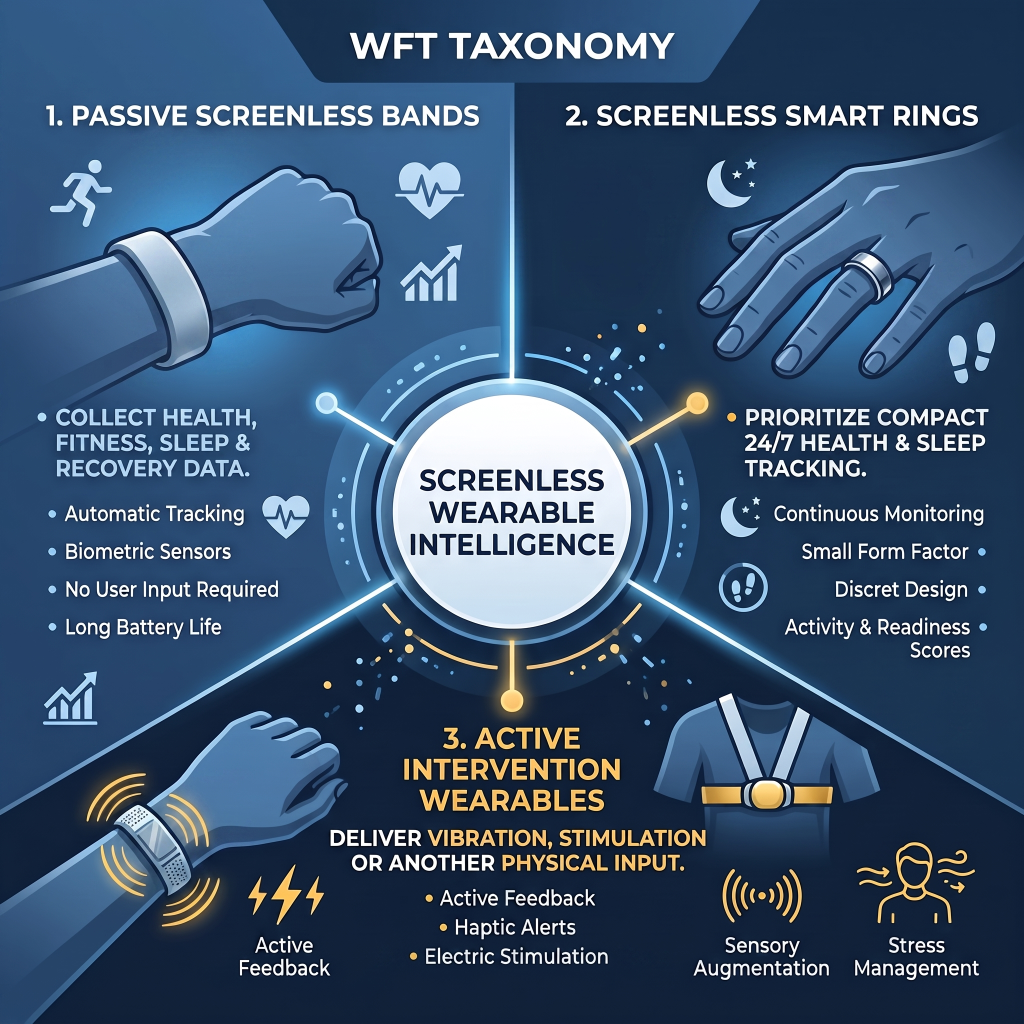
This category of screenless wearables is easier to understand when divided by what the device is designed to do—not merely where it is worn.
1. Passive Screenless Bands
Passive bands continuously collect signals such as heart rate, movement, sleep, heart rate variability, skin temperature or blood oxygen estimates. Depending on the product, the software may turn these signals into activity goals, sleep scores, readiness guidance, training load or recovery recommendations.
Representative products include:
- Google Fitbit Air
- Garmin CIRQA
- Polar Loop
- WHOOP 5.0 and WHOOP MG
- Amazfit Helio Strap and Helio Strap Pro
These devices may look similar, but their purposes differ considerably.
Fitbit Air is positioned around comfortable 24/7 tracking and AI-supported health coaching. Garmin CIRQA extends Garmin’s health and performance ecosystem into a discreet band without requiring a subscription for its core experience. Polar Loop emphasizes screen-free and subscription-free sleep, activity and recovery tracking. WHOOP uses a membership-led model built around strain, sleep, recovery and longer-term performance. Amazfit Helio Strap combines daily recovery tracking with wrist or upper-arm heart-rate monitoring.
This is why “screenless” should be treated as a form of interaction—not as a guarantee that two products serve the same user.
2. Screenless Smart Rings
Smart rings place miniature sensors around the finger rather than the wrist. The form factor can be discreet and comfortable for sleep and everyday health tracking, although comfort depends on sizing, finger swelling, training style and the activities a user performs.
Representative products include:
- Oura Ring
- RingConn
- Ultrahuman Ring
Smart rings commonly emphasize sleep, recovery, readiness, stress and long-term health trends. They can suit people who already wear a traditional watch or who do not want any band on the wrist.
However, rings can be inconvenient during weight training, climbing, manual work or activities where the device is exposed to pressure and scratching. Correct sizing is also more important than it is with an adjustable band.
3. Active Intervention Screenless Wearables
Not every screenless wellness device is primarily a tracker.
In contrast, active intervention wearables deliver a physical input intended to influence the user’s experience or routine. Apollo Neuro, for example, uses programmed vibrations called Smart Vibes to calm the nervous system and is positioned around stress relief, sleep and focus support. Additionally, other products may use haptics, light, electrical stimulation or temperature.
This creates an important distinction:
- Passive wearables measure and interpret
- Active wearables attempt to deliver an intervention
Some future devices may do both. For now, buyers should avoid assuming that a passive recovery score and an active wellness device are equivalent simply because both products are screenless.
WFT Category Insight
“Screenless wearable” describes how a device fits into your attention and technology environment. It does not, by itself, describe the device’s purpose. Goal, evidence, software and ownership cost remain more useful buying criteria than the absence of a display alone.
How Screenless Wearables Work Without a Display
Removing the screen changes where interaction happens, but the fundamental measurement process remains similar to other connected wearables.
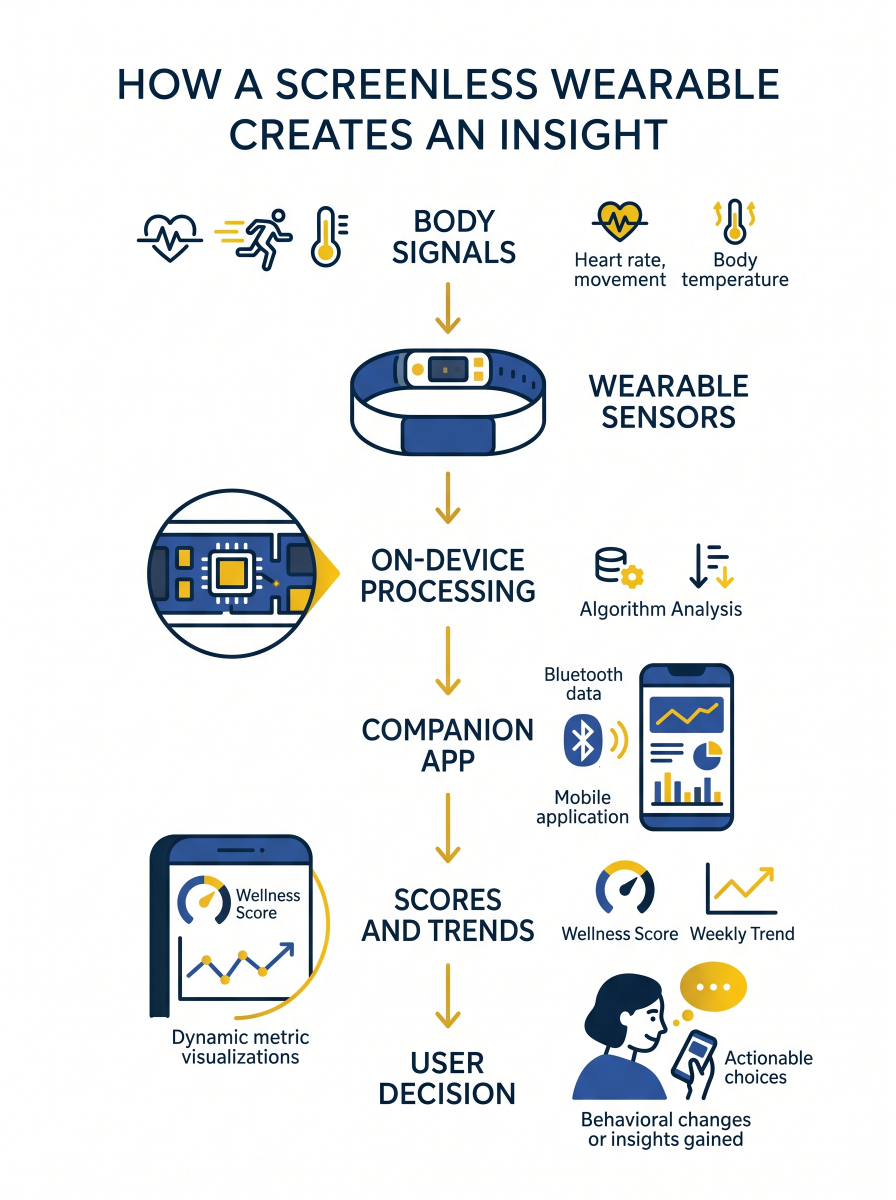
Step 1: Sensors Collect Signals
Depending on the device, these may include:
- Optical heart-rate signals from a PPG sensor
- Motion from accelerometers and gyroscopes
- Skin temperature trends
- Blood oxygen estimates
- Electrical heart signals on products with ECG capability
- Respiratory and sleep-related patterns inferred from multiple signals
The device records raw or partially processed signals while it is being worn.
Step 2: On-Device Software Processes and Stores Data
Firmware filters signals, identifies movement and may calculate basic values before synchronization. Some devices can store several days or weeks of data when the phone is not nearby, although capacity and offline functionality vary.
Step 3: The Device Synchronizes With a Companion App
Bluetooth is commonly used to transfer data to a compatible iPhone or Android phone. The app becomes the place where users view trends, initiate supported functions, manage settings and install firmware updates.
Step 4: Algorithms Turn Measurements Into Insights
Raw signals are rarely the final product. Algorithms may combine heart rate, heart rate variability (HRV), movement, sleep history and personal baselines to estimate:
- Sleep stages and Sleep Score
- Recovery or readiness
- Training load or strain
- Stress patterns
- Energy or body-resource scores
- Activity targets
- Changes from a personal baseline
These results are estimates created by each company’s sensor system and software. Similar names do not mean that different brands calculate a metric in the same way.
Step 5: The App or AI Coach Recommends an Action
The newest generation of screenless wearables increasingly competes on interpretation. Instead of displaying more graphs, the software may suggest a sleep target, training adjustment, recovery day or achievable activity goal.
This is where the screenless model becomes software-led: the sensor collects the data, but the app determines whether the data becomes useful.
Why Are Screenless Wearables Becoming More Popular?
The category of screenless wearables is growing because it addresses several limitations of conventional smartwatches and display-based fitness trackers.
Fewer Visual Interruptions
A screenless wearable cannot show a stream of messages, app alerts or animated goals. For users who already spend much of the day around phones and computers, this can make the wearable feel less demanding.
It does not eliminate digital distraction completely—the app still exists—but it changes the default interaction from repeated wrist-checking to intentional review.
Greater Emphasis on Passive Tracking
Many people want the benefits of long-term health and activity trends without regularly operating another device. A screenless design encourages a wear-and-review-later pattern that can suit sleep, recovery and general wellness monitoring.
Better Compatibility With a Traditional Watch
A person may want health tracking without replacing a mechanical watch, luxury watch or sports watch used for specific activities. A discreet band, upper-arm tracker or smart ring makes a two-device setup more practical.
Potential for Longer Battery Life
A display consumes power, especially when it is bright or frequently active. Removing it can support longer battery life or a smaller device.
However, screenless does not automatically mean exceptional endurance. Sensor frequency, wireless synchronization, processor efficiency, battery size and enabled health features also affect how long a device lasts.
Comfort and Overnight Wear
Sleep insights require consistent overnight wear. Smaller bands and rings can be easier to keep on than a large smartwatch, although comfort is highly personal.
The most useful sleep tracker is not simply the one with the longest feature list. It is the one a person can wear consistently enough to build reliable trends.
The Rise of AI-Led Health Guidance
When a wearable has no display, the companion software must do more of the explanatory work. This aligns with the industry’s broader shift from data collection toward AI-supported interpretation and coaching.
The opportunity is meaningful, but so is the risk: advice quality, transparency and access to features can vary. An impressive AI label does not guarantee accurate measurement or useful recommendations.
Main Limitations of Screenless Wearables
Removing a display solves some problems and creates others.
No Immediate On-Wrist Feedback
You usually cannot glance down to see pace, distance, heart rate, workout duration, notifications or the time.
For runners, cyclists and other athletes who adjust effort in real time, this may be a decisive limitation unless the wearable can broadcast data to a phone, bike computer, gym equipment or sports watch.
Greater Dependence on the Phone and App
The phone becomes the display. If the app is confusing, slow or unavailable, the hardware may offer little standalone value.
Buyers should therefore evaluate the ecosystem—not just the band or ring.
The Software May Sit Behind a Subscription
Some products provide their core experience without a mandatory membership. Others reserve coaching, deeper insights or even ongoing use of the hardware for a recurring fee.
The purchase price can therefore be a poor measure of long-term value. A fair comparison should include at least three years of ownership costs.
Passive Data Can Become Passive Overload
A device may be physically quiet while its app still produces too many scores, warnings or recommendations. Screenless hardware does not automatically create a calmer relationship with health data.
People who are prone to anxiety or data fixation may benefit from reviewing trends less frequently, disabling unnecessary alerts or choosing a simpler product.
Accuracy Still Varies
Removing the screen does not improve sensor accuracy by itself. Results can be affected by fit, placement, movement, skin contact, environmental conditions, algorithms and the type of activity.
Optical heart-rate tracking may perform differently during rest, running, strength training and high-intensity intervals. Consumer sleep stages are estimates rather than replacements for clinical polysomnography.
WFT recommends focusing on consistent trends and personal baselines rather than treating every individual value as a clinical fact. Read our complete guide to wearable device accuracy for a deeper explanation.
Privacy Moves Into the Background Too
A quiet device may collect heart rate, sleep, temperature, movement, reproductive-health and location-related data continuously. The absence of a display can make that collection feel less visible, not less sensitive.
Before choosing a platform, assess account security, data export and deletion options, third-party sharing, app permissions and the company’s privacy policy. WFT’s wearable data privacy guide provides a practical checklist.
Important Health Limitation
Most consumer screenless wearables are wellness or fitness products, not substitutes for medical diagnosis or professional care. Regulatory status is feature- and region-specific. Seek qualified medical advice for symptoms, urgent alerts or decisions involving a health condition.
The Screenless Wearable Landscape in 2026
The screenless wearables category now spans passive wrist and arm trackers, smart rings, membership-led performance platforms and active-intervention wearables. The representative products below illustrate how their form, purpose, battery life and ownership models differ.
Google Fitbit Air
- Form
- Wrist band
- Primary positioning
- Everyday health, sleep, readiness and AI-supported coaching
- Claimed battery
- Up to one week
- Ownership model
- Core device and Google Health app; Google Health Premium unlocks Gemini-powered coaching
- Best understood as
- A wellness-first passive tracker
Garmin CIRQA
- Form
- Wrist band with optional upper-arm wear
- Primary positioning
- Health, sleep, activity, recovery and Garmin ecosystem continuity
- Claimed battery
- Up to 10 days
- Ownership model
- No subscription required for core tracking; optional Garmin Connect+ features
- Best understood as
- A fitness and performance-oriented passive tracker
Availability: Available from Garmin in the US; release timing varies by market.
Polar Loop
- Form
- Wrist band
- Primary positioning
- Sleep, recovery, daily activity and habit support
- Claimed battery
- Up to 8 days
- Ownership model
- Subscription-free
- Best understood as
- A wellness and fitness passive tracker
WHOOP 5.0 / MG
- Form
- Wrist band with alternate body-wear options
- Primary positioning
- Strain, sleep, recovery, performance and healthspan
- Claimed battery
- 14+ days
- Ownership model
- WHOOP membership required
- Best understood as
- A membership-led recovery and performance platform
Amazfit Helio Strap
- Form
- Wrist or upper-arm band
- Primary positioning
- Continuous heart rate, training, recovery and Amazfit ecosystem continuity
- Claimed battery
- Up to 10 days
- Ownership model
- No required subscription
- Best understood as
- A training and recovery tracker
Availability: The standard Helio Strap is listed as “Coming Soon” on Amazfit’s US product page as of August 2026.
Oura Ring 5
- Form
- Smart ring
- Primary positioning
- Sleep, readiness and long-term health trends
- Claimed battery
- Typically 6–9 days, depending on size and use
- Ownership model
- Oura membership unlocks the full experience; functionality is limited without it
- Best understood as
- A premium health and recovery ring
RingConn Gen 3
- Form
- Smart ring
- Primary positioning
- Sleep, continuous health trends and proactive vibration alerts
- Claimed battery
- 10–12 days with vibration on; 11–14 days with vibration off
- Ownership model
- No subscription required for core health insights
- Best understood as
- A long-battery health ring with proactive alerts
Ultrahuman Ring PRO
- Form
- Smart ring
- Primary positioning
- Recovery, sleep and the wider Ultrahuman metabolic-health ecosystem
- Claimed battery
- Up to 15 days; approximately 12 days in Turbo Mode
- Ownership model
- No recurring subscription required for access to core ring data
- Best understood as
- A subscription-free health and recovery ring
Availability: Ring PRO remains listed for pre-order on Ultrahuman’s US page as of August 2026; availability may differ by market.
Apollo Neuro
- Form
- Wrist, ankle or arm band, with an apparel clip option
- Primary positioning
- App-controlled vibration patterns intended to support stress, relaxation, focus, energy and sleep routines
- Claimed battery
- At least 12 hours of play time; up to 20 hours depending on use and intensity
- Ownership model
- SmartVibes membership required; the current starter kit includes one year
- Best understood as
- An active wellness-intervention wearable rather than a conventional passive tracker
Evidence note: Battery figures, ownership models and availability statements are manufacturer claims checked in August 2026. Actual battery life varies with settings, sensors, usage and device age. Availability and included features may differ by country. This is a representative landscape rather than an exhaustive list or a product ranking.
Screenless Band vs Smart Ring: Which Form Factor Fits Better?
Neither form factor is universally superior since the better choice depends on comfort, training, preferred wearing location and the role the device will play.
| Decision factor | Screenless band | Smart ring |
| Typical wearing position | Wrist; some support upper arm or other body locations | Finger |
| Adjustability | Usually easy to tighten or loosen | Requires correct ring size |
| Sleep wear | Often comfortable when light and well fitted | Very discreet for many users |
| Strength training | Usually more practical than a ring | May be uncomfortable or vulnerable during barbell and grip work |
| Live workout data | Some can broadcast heart rate to other equipment | Usually less focused on live feedback |
| Traditional-watch compatibility | Can be worn on the opposite wrist or upper arm | Leaves both wrists free |
| Surface durability | Bands and modules can show wear but are usually less exposed to gripping surfaces | Rings may scratch or experience pressure during manual activities |
| Main strength | Flexible daily wear and broader fitness use | Compact passive health and sleep tracking |
Choose the form you are most likely to wear consistently. A technically advanced sensor produces limited value when discomfort, charging habits or lifestyle conflicts create regular gaps in the data.
Screenless Wearables vs Smartwatches
Screenless wearables and smartwatches solve different problems.
A smartwatch is designed for direct interaction, displaying important metrics such as maps, pace, messages, apps, timers and workout metrics. It may replace some phone interactions and can be valuable during training.
On the other hand, a screenless wearable is designed to reduce on-device interaction, prioritizing background collection and app-based interpretation.
Subscription vs Subscription-Free Screenless Wearables
The screenless category makes software unusually important. That makes the ownership model one of the most important comparison points.
Subscription-Free Does Not Mean Software-Free
Garmin CIRQA, Polar Loop and Amazfit Helio Strap provide core tracking and insights without a required monthly membership. RingConn and Ultrahuman also emphasize access to core ring data without a recurring subscription.
The software is still central—it is simply included in the hardware purchase rather than financed through a mandatory ongoing fee.
Membership-Led Products
WHOOP is the clearest example of a service-led wearable. The membership funds continued access to the device experience, analysis and coaching.
Other platforms may allow basic tracking without a subscription but reserve advanced coaching, reports or insights for a paid tier. Google states that Fitbit Air’s Gemini-based Google Health Coach is included with Google Health Premium. Oura’s complete experience is also tied to membership.
Calculate the Three-Year Cost
Before buying, compare:
- Device price
- Required membership cost
- Optional premium features you are likely to use
- Replacement bands, sizing kits or chargers
- Expected replacement cycle
A low initial price can become the more expensive option over time. A higher upfront price may deliver better value if the core experience remains available without a fee.
Which Screenless Wearable Category Matches Your Goal?
This guide does not rank individual products. Its purpose is to help identify the right category before a product comparison begins.
Everyday Wellness and Healthy Habits
Look for a lightweight band or ring with strong sleep, activity and long-term trend reporting. App clarity and comfort matter more than the number of advanced training metrics.
Fitbit Air and Polar Loop illustrate the wellness-first band approach, while Oura, RingConn and Ultrahuman represent the smart-ring route.
Athletic Training and Recovery
Prioritize reliable workout heart rate, training load, recovery context, data export and compatibility with the rest of your training stack.
Garmin CIRQA, WHOOP and Amazfit Helio Strap show three different models: an established sports ecosystem, a membership-led performance platform and a more affordable subscription-free training sensor.
Athletes who need live pace, navigation or detailed workout screens may still need a sports watch or bike computer.
Sleep and Recovery
Comfort, battery consistency, baseline quality and the clarity of the recovery model should lead the decision.
Avoid choosing solely on the number of sleep stages or scores shown in marketing. Consumer wearables infer sleep from indirect signals, and results should be used to understand patterns rather than diagnose a sleep disorder.
Reduced Digital Distraction
Choose a product whose app behavior supports the same calm-technology goal as its hardware. Review notification controls, coaching frequency and whether the platform encourages constant score-checking.
The best low-distraction wearable is not merely one without a screen. It is one that helps you review useful information without turning health into another attention loop.
Wearing Alongside a Traditional Watch
A smart ring leaves both wrists free. A slim band can be worn on the opposite wrist, while some products support upper-arm placement.
Check whether moving the device changes feature availability or sensor accuracy. A product designed and validated for one position should not be assumed to perform identically elsewhere.
Active Stress or Wellness Support
If the goal is to receive a physical intervention rather than only measure a stress proxy, investigate active wellness wearables separately.
Ask what the device delivers, what outcomes its evidence supports, whether a subscription is involved and whether it also tracks any physiological response. WFT covers this distinction in our Apollo wearable vs passive trackers guide.
How to Choose a Screenless Wearable
Use this sequence to narrow the field.
Step 1: Define the Primary Goal
Choose one leading goal:
- Everyday health and activity
- Sleep
- Recovery and readiness
- Athletic performance
- Stress and wellbeing
- Continuous tracking alongside another watch
- Reduced digital distraction
A device can support several goals, but its software will usually reveal which one has priority.
Step 2: Decide Whether You Need Live Feedback
If you need pace, navigation, timers or workout metrics on your body, a fully screenless product may not be enough.
Look for heart-rate broadcast or integration with a phone, bike computer, gym equipment or watch—or keep a display-based sports device for workouts.
Step 3: Choose Band, Upper Arm or Ring
Think about sleep comfort, grip-based training, manual work, personal style and whether you already wear a watch.
Step 4: Evaluate the App Before the Hardware
Review:
- Dashboard clarity
- Coaching and recommendations
- Data export
- Third-party integrations
- Android and iOS compatibility
- Accessibility
- Subscription restrictions
For screenless wearables, the app is part of the product—not an optional extra.
Step 5: Calculate Long-Term Cost
Compare three years of ownership rather than the checkout price alone.
Step 6: Check Evidence and Testing Status
Separate official specifications, hands-on impressions and independently completed testing. Be cautious when a new device has received only launch-day coverage.
Step 7: Review Accuracy and Health Limitations
Look for validation relevant to your priority metric and activity type. An accurate resting heart-rate trend does not prove equal performance during strength training or intervals.
Step 8: Review Privacy and Data Control
Understand what is collected, where it is processed, whether it is shared and what happens when you leave the platform.
For a broader buying process, use WFT’s How to Choose the Best Wearable Fitness Tracker guide.
The Future of Screenless Wearable Technology
Screenless wearables point toward a future in which health technology becomes less visually demanding and more context-aware.
The Hardware Will Become Quieter
Bands and rings will continue to become smaller, lighter and easier to wear in more situations. Alternative wearing positions and sensor modules that move between accessories may also become more common.
The Software Will Become More Important
As the display disappears, the competitive advantage moves toward:
- Better interpretation
- More useful coaching
- Stronger personal baselines
- Clearer explanations
- Responsible AI
- Easier integration with other health and training platforms
The winning products may not be those that collect the most metrics. They may be those that decide what deserves the user’s attention—and what does not.
Screenless Will Not Mean Phone-Free
Most current devices still depend heavily on a smartphone. The category reduces on-body screen interaction, but it does not eliminate the wider digital ecosystem.
Meaningful progress will require apps that summarize information efficiently instead of transferring the burden of checking from the wrist to the phone.
Passive Tracking and Active Intervention May Converge
Future wearables may detect a change, recommend a response and deliver an intervention through one system.
That possibility raises important questions about evidence, consent, safety, automation and user control. WFT will evaluate these products not only by what they can sense, but by what they do with the information.
Ownership Models Will Shape Adoption
Consumers are already comparing subscription-free products with membership-led platforms. Long-term cost, feature access after cancellation and data portability will become central parts of the buying decision.
Accuracy and Trust Will Matter More Than Novelty
As wearables make increasingly personalized claims, users will need clearer evidence about what is measured directly, what is estimated and what is generated by an algorithm.
The future of screenless wearable intelligence depends on trust—not merely invisibility.
Frequently Asked Questions
What is a screenless wearable?
A screenless wearable is a body-worn connected device that tracks fitness, health or wellness—or delivers an active wellness function—without using a conventional display as its primary interface. Detailed data and controls are normally accessed through a companion app.
How does a screenless fitness tracker work?
Sensors collect signals such as heart rate and movement. On-device software processes and stores the data, which is then synchronized to a phone app. The app’s algorithms turn those signals into activity, sleep, recovery or health insights.
Are screenless fitness trackers accurate?
Accuracy varies by device, metric, placement and activity. The absence of a screen does not make a tracker more or less accurate by itself. Fit, sensors, algorithms and real-world conditions have a greater effect.
Do screenless wearables need a phone?
Most need a compatible phone for setup, synchronization, detailed insights and settings. Some can record data temporarily while the phone is not nearby, but offline storage and standalone functions vary.
Can a screenless wearable track workouts?
Yes, but the workout experience differs. Some automatically detect activities or allow workout recording through the app. Performance-oriented models may broadcast heart rate to a watch, bike computer, gym machine or training app. They cannot show live metrics on the wearable itself.
Are smart rings screenless wearables?
Yes. Smart rings are one of the main screenless wearable form factors. They usually focus on sleep, recovery and continuous health trends rather than notifications or on-device workout displays.
Do all screenless fitness trackers require a subscription?
No. Garmin CIRQA, Polar Loop and Amazfit Helio Strap provide core experiences without a required subscription, while WHOOP uses a membership model. Other platforms combine basic access with optional or premium coaching and insights.
Are screenless wearables good for athletes?
They can be useful for recovery, sleep and continuous tracking. Athletes who need live pace, navigation or workout guidance may still require a sports watch, phone, bike computer or another display.
Can a screenless wearable replace a smartwatch?
It can replace a smartwatch for users who mainly want passive health, sleep or activity tracking. It is less suitable for people who rely on notifications, apps, navigation, calls or real-time workout information on the wrist.
Are screenless wearables medical devices?
Most are consumer fitness or wellness products. Certain features may have regulatory clearance in specific countries, but that status does not apply automatically to every metric or the entire device. They should not replace medical diagnosis or professional care.
Final Perspective
Screenless wearables are not a rejection of wearable technology. They are a redesign of the relationship between the user, the device and the data.
The most promising products reduce unnecessary interaction while preserving the insights that help people understand activity, sleep, recovery and health. But the absence of a display should never be mistaken for proof of accuracy, comfort, simplicity or value.
The right choice depends on the job the device must perform:
- A wellness-first band can support everyday habits and sleep.
- A performance band can extend training and recovery tracking.
- A smart ring can provide discreet health monitoring while leaving both wrists free.
- An active intervention wearable can serve a different purpose by delivering an experience rather than simply measuring one.
WFT’s role is to make those differences clear, test the claims that can be tested and help readers choose technology that fits their goals without demanding more attention than it deserves.
Continue Exploring Screenless Wearables
Explore individual devices, different approaches to passive health monitoring and the broader wearable categories connected to the shift toward screen-free technology.